Free Jigsaw Puzzles Online: Rules, Tips, and Games

Free jigsaw puzzles online turn a picture into shuffled pieces that you rebuild in a browser. Start by finding corners and straight-edged pieces, assemble the border, sort the remaining pieces by color or pattern, and complete one recognizable area at a time. Most online puzzles use drag-and-drop controls, require no download, and are finished when every piece is in its correct position.
What are the rules of online jigsaw puzzles?
The basic rule is simple: place every piece where its shape and image details match the completed picture.
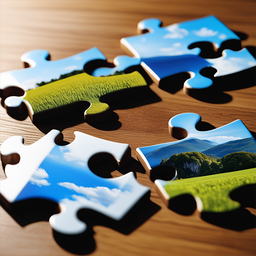
A traditional jigsaw begins with a reference image divided into interlocking pieces. The pieces are shuffled, and your job is to restore the original image. Online versions normally let you select a piece, drag it across the board, and release it near a possible position. A correctly placed piece may snap into place or connect to its neighbors.
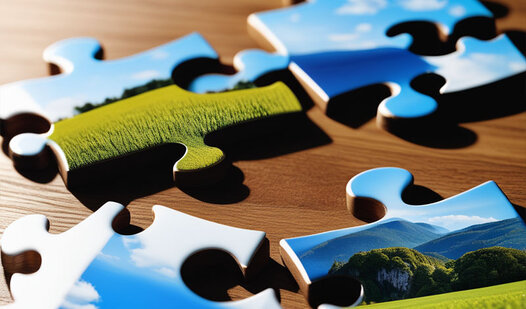
Corner pieces have two straight sides, while other border pieces have one. Interior pieces have no straight outer edge. Tabs, slots, colors, lines, and textures all provide clues, but a convincing color match is not enough if the shapes do not fit.
Some puzzles allow rotation, although many browser versions keep every piece facing the correct direction. Timers, move counters, hints, preview images, and selectable piece counts are optional features rather than universal rules. Unless a specific game says otherwise, there is usually no penalty for testing a piece and moving it again.
How do you play jigsaw puzzles step by step?
Use a repeatable search-and-sort process so that each placement reduces the number of possibilities left on the board.
- Preview the picture to build a map. Notice the main subjects, large color regions, strong lines, repeated textures, and the location of the brightest and darkest areas.
- Separate the corners to create anchors. Place the four pieces with two straight sides near the corresponding corners of the workspace.
- Collect the border pieces to define the puzzle. Group pieces with one straight edge, then connect them by matching both shape and nearby image details.
- Sort interior pieces to shrink the search. Make loose groups for sky, foliage, faces, lettering, buildings, shadows, or any other recognizable feature.
- Build distinctive sections to create landmarks. Assemble an eye, window, sign, horizon, or high-contrast object before tackling broad areas with little detail.
- Join small clusters to reveal relationships. Move completed groups around the board and compare their boundaries with the reference image.
- Fill narrow gaps to limit the candidates. Once a space has neighbors on two or three sides, use their shapes and colors to identify the missing piece.
- Re-sort the leftovers to finish efficiently. Arrange remaining pieces by tab-and-slot pattern or dominant color instead of repeatedly scanning a random pile.
- Check the whole image to confirm completion. Look for unfilled gaps, disconnected clusters, or a piece resting near its position without actually snapping into it.
How do you solve jigsaw puzzles faster?
Solve faster by organizing the board well, choosing information-rich pieces first, and avoiding repeated searches through the same unsorted pile.
The best early pieces are not always border pieces. A bright sign, a face, a unique object, or a sharp diagonal line may be more useful than a nearly featureless strip of border. Build whichever section gives you the strongest combination of color, shape, and known location.
Keep unused pieces visible whenever the game provides enough space. Overlapping pieces hide clues and make you inspect the same objects repeatedly. If the board is crowded, create separate working zones: borders on one side, distinct objects on another, and low-detail pieces farther away.
Match image evidence before testing shapes. A tab that fits a slot only proves that two pieces could connect geometrically; the printed line, gradient, or texture must also continue naturally. For example, a horizon should cross the join at the same height, and a curved outline should not change direction unexpectedly.
Large uniform areas need a different method. Sort those pieces by shape: four slots, four tabs, opposite tabs, adjacent tabs, and mixed patterns. Then examine subtle changes in brightness or texture. Work from an already completed boundary inward so that each empty position has more constraints.
If hints are available, save them for genuinely ambiguous sections. Using one on a distinctive object often wastes information you could have discovered easily. A hint is more valuable when the remaining pieces share nearly identical colors or patterns.
How do you win at a jigsaw puzzle?
You win by completing the picture, but a clean solve depends more on reducing uncertainty than on making rapid guesses.
Jigsaws usually have no opponent and may not have a losing condition. Your practical goal can therefore change: complete the image, beat your previous time, use fewer hints, attempt more pieces, or solve without consulting the preview. For a first attempt, accuracy and organization matter more than speed.
Treat every connected section as evidence. Its image tells you roughly where it belongs, while the exposed tabs and slots tell you which pieces may continue it. The most useful next move is often the one that creates several new clues, not the move that fills an isolated spot.
If you care about time, measure comparable attempts. A 100-piece puzzle with rotation is not equivalent to a 100-piece puzzle whose pieces are already upright. Image complexity also matters: a detailed street scene may offer more landmarks than a simple blue sky, despite using the same number of pieces.
What are the best free jigsaw puzzles online?
The best free jigsaw puzzle has clear pieces, dependable controls, a readable reference image, and a difficulty level that keeps you thinking without turning the search into visual clutter.
Start with a modest piece count if you are learning the interface or playing on a phone. Larger puzzles benefit from a desktop screen because you can keep more pieces visible around the board. Helpful quality-of-life options include zoom, a full-picture preview, separated edge pieces, saved progress, and adjustable difficulty. None is essential, but each can make a long puzzle easier to manage.
Daily-format games suit players who prefer one contained challenge as part of a routine. The Daily Jigsaw listing is a natural place to begin if that framing appeals to you. For a broadly named traditional option, Jigsaw Puzzles provides another catalog entry to compare. Jigsaw Puzzle Go gives you an additional jigsaw listing when you want to test which board and controls feel most comfortable.
Not every game using the word jigsaw follows the classic picture-piece format. Hybrid titles may borrow the ideas of fitting shapes, reconstructing patterns, or reasoning about spatial relationships. Jigsaw Blocks is worth considering when you want a block-oriented variation rather than assuming that every catalog result uses identical rules. Check the opening instructions because hybrid mechanics can differ substantially from traditional jigsaws.
What mistakes do beginners make in jigsaw puzzles?
The most common mistakes are leaving pieces in a random pile, trusting color alone, and spending too long forcing one difficult section.
Building the entire border first is useful, but it is not mandatory. On a low-contrast image, a distinctive interior object may provide much better progress. Likewise, staring at one apparent match can create tunnel vision. If a piece almost fits, set it aside; correct jigsaw connections should not require persuasion.
Another mistake is making categories that are too broad. A single blue pile may mix sky, water, clothing, and painted objects. Divide it by gradient, texture, edge direction, or nearby secondary colors. Small, meaningful groups are faster to search than one large color group.
Players also forget to use the reference image spatially. Do not merely ask what a piece depicts. Ask where that feature sits: above the horizon, beside a face, at the lower-left edge, or near a vertical line. Position is often the clue that separates several visually similar pieces.
What types of online jigsaw puzzles are there?
Online jigsaws range from classic picture assembly to timed, daily, rotating, irregular, and genre-hybrid puzzles.
Classic puzzles keep pieces upright and focus on reconstructing a photograph or illustration. Rotating puzzles require you to correct orientation as well as position. Daily puzzles offer a recurring challenge, while timed modes emphasize quick recognition and efficient board management. Adjustable puzzles let you change the number of pieces, making the same image suitable for a short break or a longer session.
Irregular-cut puzzles use unusual piece shapes and may reduce the usefulness of familiar tab-and-slot categories. Mystery puzzles hide or limit the completed preview, so you must infer the picture while assembling it. Double-sided physical puzzles have no exact browser equivalent in most catalogs, but online games can create similar uncertainty through concealed images, restricted previews, or repeated textures.
Hybrid games may combine jigsaw logic with blocks, cards, number placement, or other spatial systems. Approach them as related puzzle games rather than expecting traditional rules. Read the objective first, identify what counts as a legal placement, and then transfer the core jigsaw habit: organize possibilities before testing them.
FAQ
Can I play free jigsaw puzzles online without downloading anything?
Yes. Browser-based jigsaw games normally run directly on the game page, although exact device and browser requirements can vary.
What is the easiest way to start a jigsaw puzzle?
Preview the image, separate corners and edges, then build one distinctive interior feature while assembling the border.
Should I always complete the border first?
No. The border is a reliable framework, but a colorful or highly recognizable interior section may provide faster progress on difficult images.
How many jigsaw pieces are good for a beginner?
Choose a count that leaves every piece readable on your screen. A small or moderate puzzle is better for learning the controls; increase the count after you can sort and navigate comfortably.