
Best Ball Sort Puzzle Games and How to Win

The best ball sort puzzle games have clear colors, responsive controls, and levels that reward planning rather than random tapping. Your goal is to group every color into its own tube: move the top ball onto a matching color or into an empty tube, then continue until each filled tube contains only one color. Start by exposing buried balls and protect at least one empty tube for maneuvering.
What are ball sort puzzle games?
Ball sort puzzle games are color-sorting logic puzzles in which you rearrange stacked balls among a limited number of tubes.
A typical level begins with several colors mixed together. Each tube holds a fixed number of balls, often four, while one or more tubes begin empty. Because you can normally move only the top ball, the real challenge is not recognizing matching colors. It is uncovering the balls you need without blocking the next part of the solution.
These games are easy to understand because every move has a visible result. Their deeper levels resemble compact planning puzzles: a move that creates a pair now may trap another color underneath, while an apparently unproductive move may open the whole board two turns later.
What are the rules of ball sort puzzles?
The standard rule is simple: move a top ball into an empty tube or onto a ball of the same color, provided the destination has space.
You cannot usually take a ball from the middle of a stack. You must remove every ball above it first. A tube is complete when all its occupied positions contain one color, and the level is won when every color has been separated into a completed tube.
Some games move one ball per tap. Others automatically move a connected group of matching top balls when enough space is available. Tube capacity, undo limits, hints, and the number of spare tubes can also differ. Check what happens on the first few moves before planning around a particular transfer rule.


Use this Ball Sort Puzzle as a baseline for learning the standard loop: inspect the top layer, create matching groups, and notice how valuable an open tube becomes as the board fills.
How do you play ball sort puzzles step by step?
Follow a deliberate sequence so that each move either exposes useful information or improves the board.
- Scan every tube to identify the top colors. This shows which matches are immediately available and which colors are buried.
- Find the most accessible pair. Combining matching top balls reduces clutter without requiring a long setup.
- Choose a temporary workspace. Reserve an empty tube for balls that must move out of the way.
- Trace the next buried ball before moving. Knowing what a move uncovers prevents you from exposing a color with nowhere legal to go.
- Build matching stacks from the bottom. A stable pair or trio can become the foundation of a completed tube.
- Free a mixed tube when possible. Creating another empty tube gives you more ways to reorganize blocked stacks.
- Complete colors that no longer obstruct anything. A safely finished tube removes one color from the puzzle and simplifies later decisions.
- Review the board before the final pours. Confirm that each remaining color has enough space to gather without dismantling finished groups.
Do not judge a move only by whether it joins two matching balls. A strong move may simply reveal an important color, empty a tube, or preserve access to several options.
How do you win at ball sort puzzle games?
You win consistently by managing empty space, planning beyond the next match, and avoiding stacks that cannot be separated legally.
Treat empty tubes as working memory. An empty tube is not wasted space. It lets you hold a blocking ball while reorganizing the tube beneath it. Filling every spare tube with unrelated colors may leave the board technically unfinished but practically frozen. When possible, keep one tube empty or easy to clear.
Read each tube from top to bottom. Suppose a blue ball sits above red, while another blue is available elsewhere. Combining the blues looks attractive, but first ask where the exposed red will go. Reading the hidden sequence turns random experimentation into a short plan.
Plan in two- or three-move chains. Think in terms of move, reveal, and place. Move the blocker, reveal the target, then transfer that target to a useful stack. If the third move is illegal, the first move probably needs a different destination.
Prefer moves that increase mobility. A move is especially valuable when it empties a tube, reveals a match, or consolidates a color without consuming the last free space. Completing a tube is helpful, but freeing a tube can be even more important during the middle of a level.
Build on reliable foundations. If several balls of one color are already together at the bottom of a tube, avoid placing a different color over them unless you know how it will be removed. Stable lower stacks are easier to finish than scattered pairs balanced above unrelated colors.
Use undo as analysis, not as a substitute for analysis. If the game offers undo, test a short sequence and examine exactly where it fails. Then return to the decision that caused the blockage. Repeating the same final moves rarely helps when the real mistake happened much earlier.
Restart when the position has lost flexibility. A restart is useful after you discover the order of hidden balls. On the next attempt, preserve a destination for the color that previously became trapped. The information gained from a failed attempt makes the new run easier.
What mistakes make ball sort puzzles harder?
The most common mistake is filling an empty tube simply because a legal move is available.
Another is chasing every visible match. Two matching balls do not always belong together immediately. Joining them can consume the only destination needed to uncover a third color. Before making a match, check the balls directly below both source stacks.
Beginners also finish a color too early and then dismantle it to recover space. Complete a tube only when its color is no longer needed as temporary storage and finishing it does not eliminate your last useful workspace.
Avoid spreading one color across several partial stacks. Three separate blue pairs may look like progress, but they occupy more tube space than one concentrated blue stack. Consolidation usually creates more mobility.
Finally, do not continue tapping after recognizing a dead end. Stop, identify the earliest move that reduced your options, and undo to that point. The last legal move is often not the move that caused the problem.
What ball sort puzzle variants can you play?
Most variants keep the same planning principle but change how information is presented or how forgiving the controls are.
Classic versions use solid-colored balls and uniform tubes. Emoji variants add symbols, which can make groups easier to distinguish and provide another visual cue besides color. Some versions transfer one ball at a time, while others move an entire matching top group. Games may also add locked tubes, limited undo, hints, extra-tube rewards, unusual containers, or more colors per level.
These changes affect tactics more than the objective. Limited undo encourages slower planning. Group transfers make destination capacity more important. Extra empty tubes reduce pressure, while fewer spare tubes demand careful temporary placement.


Try Emoji Color Ball Sort if you prefer sorting with symbolic as well as color-based cues. Use the same strategy: follow the order inside each stack instead of reacting only to the top symbols.
What are the best ball sort puzzle games to play free?
The best ball sort puzzle game is one with readable pieces, predictable move rules, quick restarting, and enough challenge to make empty-space management meaningful.
A good game should make legal destinations obvious without solving the level for you. Undo is useful for learning, but the puzzle should still reward planning. Clear feedback matters too: you should immediately understand whether a tap moved one ball, transferred a matching group, or was rejected because the destination was full.
Start with the standard Ball Sort Puzzle card above if you want to learn the core rules. Once the basic loop feels natural, compare it with these alternatives:

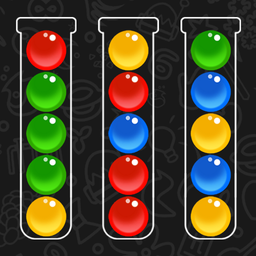
Ball Sort Master is a sensible next option for testing whether your strategy works under another level sequence. Pay attention to its transfer behavior and treat any rule differences as part of the puzzle.
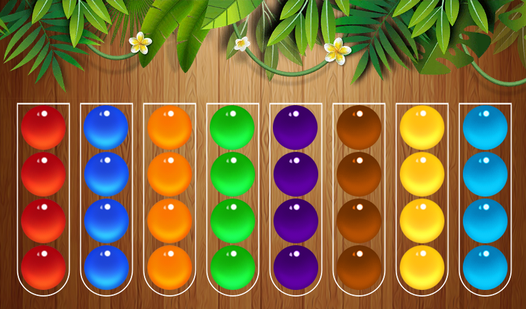
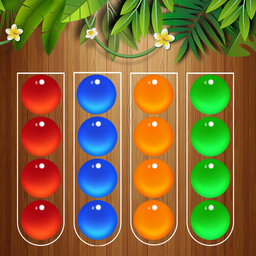
Ball Sort Color Puzzle offers another place to practice the central skill: making room before committing to a color stack. Use early levels to develop the habit of checking what each move will reveal.
No single version is automatically best for every player. Choose the one whose colors and controls you can read quickly. If you repeatedly make accidental moves or cannot distinguish pieces, the interface is adding difficulty that has nothing to do with logic.
FAQ
Are ball sort puzzle levels always solvable?
Most designed levels are intended to have a solution, but a series of legal moves can still create a dead end. Randomly generated levels may vary, so use undo or restart if no productive transfer remains.
Can I place a ball on a different color?
Usually not. A ball can normally move only into an empty tube or onto the same color, and the destination must have free capacity. Individual games may introduce special rules.
Why should I keep one tube empty?
An empty tube provides temporary storage while you expose buried balls. Without working space, otherwise useful stacks can become impossible to separate.
What should I do when I get stuck?
Look for the move that consumed your last empty space or covered a needed color. Undo to that decision, choose a different temporary destination, and plan the next two moves before continuing.