
What Is a Match 3 Game? Rules and Strategy

A match 3 game is a puzzle in which you move colored pieces to form a row or column of at least three identical items. A valid match clears those pieces, new ones fall into the board, and the process may create automatic follow-up matches called cascades. To start, look for two matching pieces with a third one a single swap away, then make the swap and work toward the level's stated goal.
The basic idea is easy to recognize, but match 3 games can demand careful planning. Some ask you to reach a score, collect particular pieces, remove covered tiles, or bring objects to the bottom of the board. Others give you a timer instead of a move limit. Understanding the objective matters more than clearing the first match you see.
What are the rules of a match 3 game?
The central rule is to align three or more matching pieces, usually by swapping two adjacent pieces horizontally or vertically.
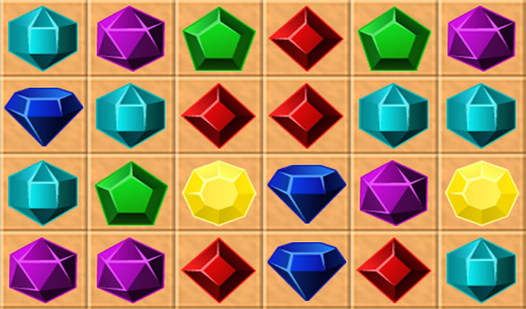
Most boards use a grid filled with gems, candy, symbols, or other colored objects. A swap is normally accepted only if it immediately creates a match, although some variants allow free movement. Once matched pieces disappear, gravity pulls pieces down and new ones enter from above. If their new positions create another match, it clears automatically as part of a cascade.
Matching four or more pieces often creates a special piece. The exact effects differ by game, but common examples clear an entire row, remove a column, explode nearby tiles, or target every piece of one color. T-shaped and L-shaped matches may produce different bonuses from straight matches. Because these conventions are not universal, check the game's first tutorial prompts before assuming that a familiar pattern has the same effect.
A level ends successfully when you complete its objective before running out of moves or time. Clearing many pieces is useful only when those clears advance that objective.
How do you play match 3 step by step?
You play by reading the goal, finding a productive swap, and using the resulting board changes to build stronger combinations.
- Read the objective to set your priority. Identify the required colors, targets, score, or special objects before making a move.
- Scan the whole board to find useful swaps. Look horizontally and vertically instead of choosing the first flashing hint.
- Match near the objective to make progress. If a target is trapped under a blocker, clear pieces beside or on top of that area.
- Build groups of four or five to create power pieces. A larger match can accomplish more than several ordinary three-piece clears.
- Combine compatible specials to affect more tiles. Save a bonus briefly if another special can be moved next to it without wasting too many turns.
- Use gravity to trigger cascades. Matches near the bottom rearrange more of the board and can create free clears above them.
- Recheck the board after every move. Falling pieces change the available patterns, so an old plan may no longer be best.
- Spend the final moves on the goal. Ignore attractive side matches when the move counter is low and a required target remains.
How do you win at match 3 games?
You win consistently by treating moves as a limited resource and choosing matches that improve both the objective and the next board position.
Start with the hardest part of the level. A central open area may remain easy to reach later, while isolated corners, narrow channels, and layered blockers can require repeated attention. Working on constrained spaces early gives random cascades more chances to help you before the move limit becomes urgent.
Prefer moves that do two jobs. A match can collect the required color while also damaging a blocker, moving an object downward, or setting up four identical pieces. Compare that with a move in an unrelated corner that produces only three cleared tiles. The first move has better value even if its immediate score is smaller.
Look one move ahead when the board is stable. Before swapping, imagine the three pieces disappearing and note what will fall into their spaces. You do not need to predict every cascade. The useful question is whether the move preserves a promising pattern, breaks it, or brings matching pieces closer together.
Special pieces are strongest when aimed at difficult areas. A row-clearing bonus placed on the same row as several blockers is more valuable than one activated on an open row. A color-removing piece should usually target a color tied to the objective or one that occupies enough of the board to cause a major reshuffle. Combining two specials can be powerful, but waiting indefinitely for a perfect pairing can also waste moves.
Finally, pay attention to the board's shape. Holes, fixed tiles, portals, and separate compartments can alter how pieces fall. A match below a target helps only if gravity can actually move that target through the available path.
What beginner mistakes make match 3 games harder?
The most common mistake is making legal matches without checking whether they serve the level's objective.
Beginners also tend to follow automatic hints too quickly. A hint usually identifies an available move, not necessarily the strongest one. Scan the board yourself before accepting it. Another mistake is activating a special piece as soon as it appears. Immediate use can be correct, but repositioning it or pairing it may produce a much larger effect.
Playing only at the top of the board limits cascades because relatively few pieces move. Matches lower down generally disturb more cells, though objective-related matches should still come first. Players also overlook corners and edges until late in the level. These spaces have fewer possible match directions, so targets there deserve early attention.
Do not chase a high score when success depends on collecting or clearing something specific. Extra points rarely compensate for failing the actual requirement. Likewise, do not spend several moves engineering a spectacular combination if two simple matches would finish the level safely.
What types of match 3 games are there?
Match 3 games differ mainly in their objectives, limits, board rules, and the systems built around the puzzle.
Move-limited level games give you a fixed number of swaps and reward efficient planning. Timed modes emphasize quick recognition and rapid chains. Endless or score-attack modes continue until no moves remain or another failure condition is reached. Some games use relaxed play with no meaningful penalty, making them suitable for short, low-pressure sessions.
Objective-based variants may ask you to collect colors, break layers, spread or remove a substance, escort objects downward, or clear designated cells. Falling-block and chain-drawing games are sometimes grouped with match 3 because they use color matching, even though their controls differ from adjacent swapping.
Many modern examples also add maps, decorating, character progression, stories, or upgrade systems. Those features provide context and rewards, but the puzzle core remains the same: recognize a pattern, create a match, and use the changed board efficiently.
What are the best match 3 games to play free?
A good free match 3 game has readable pieces, responsive controls, clear objectives, and enough board variety to reward decisions rather than blind swapping.
For a straightforward introduction, a gem-themed game is useful because distinct colors and familiar symbols make patterns easy to read. A themed option can make repeated levels feel more inviting without changing the essential rules. The catalog cards below offer different presentations of the same approachable genre, so try the theme that catches your eye and judge the game by how clearly it communicates goals and special-piece effects.
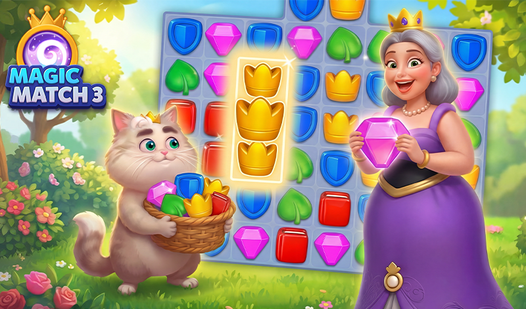
Cats Match 3 is an obvious place to start if you prefer a playful cat theme. Royal Match 3 offers a regal framing, while the earlier Magic Match 3 card suits players drawn to fantasy imagery. These descriptions refer to their catalog themes rather than promising a specific level system or power-up set.
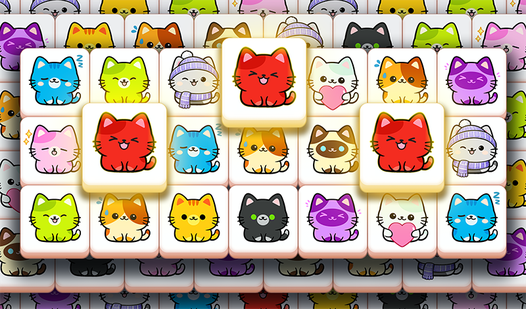

Whichever game you choose, use the opening levels to learn its visual language. Note what each blocker requires, which patterns create specials, and whether specials can be combined. Once those details are clear, the general strategy transfers easily between most match 3 boards.
FAQ
Why is it called a match 3 game?
It is named after the basic action of matching at least three identical pieces in a horizontal or vertical line.
Are match 3 games based on luck or skill?
They use both. New pieces may be generated unpredictably, but goal selection, move efficiency, setup planning, and special-piece timing give skilled play a major role.
Can you match pieces diagonally in a match 3 game?
Usually not. Most traditional games count horizontal and vertical lines, although individual variants may introduce diagonal or other matching rules.
What happens when there are no possible matches?
Most games automatically shuffle the remaining pieces. Some endless variants instead treat a board with no legal moves as the end of the run.