
Klondike vs Spider Solitaire: Rules and Strategy

Klondike and Spider are two different solitaire games. Klondike uses one 52-card deck, alternating-color tableau piles, and four suit foundations. Spider uses two decks, ten tableau columns, and complete same-suit runs from King to Ace. Start Klondike by uncovering hidden cards; start Spider by organizing movable same-suit sequences before dealing another row.
What is the difference between Klondike and Spider Solitaire?
Klondike is a foundation-building game with a stock, while Spider is a tableau-building game focused on clearing eight complete suited runs.
| Feature | Klondike | Spider |
|---|---|---|
| Cards | One 52-card deck | Two decks, 104 cards |
| Tableau | Seven columns | Ten columns |
| Main build | Down in alternating colors | Down by rank, ideally in one suit |
| Winning target | Four suited foundations, Ace through King | Eight same-suit runs, King through Ace |
| Stock | Cards are drawn to a waste pile | A new card is dealt onto every column |
| Empty column | Usually accepts only a King or King-led sequence | Accepts any card or valid movable sequence |
Klondike divides play among three areas: the tableau, the stock and waste, and the foundations. You gradually expose the face-down tableau cards while sending cards to the foundations in ascending suit order. The alternating-color rule creates useful links such as a black nine on a red ten.
Spider has no traditional four-foundation area. Cards remain in the tableau until a complete King-to-Ace sequence of one suit is formed and removed. You may usually place a card on another card one rank higher regardless of suit, but a multi-card sequence can move as a unit only when all its cards share a suit. This distinction is the heart of Spider strategy.
What are the rules of Klondike and Spider Solitaire?
Both games require descending tableau builds, but their deck layouts, movement rules, stock systems, and victory conditions are different.
In Klondike, seven columns receive one through seven cards. Only the top card of each column begins face up. Build downward in alternating colors, move valid face-up sequences together, and turn over a newly exposed face-down card. Empty columns normally accept a King or a sequence beginning with a King. Foundations begin with Aces and rise by suit to Kings. The stock may use draw-one or draw-three rules, and the number of permitted passes varies by version.
Spider begins with 54 cards spread over ten columns. The first four columns have six cards and the other six have five; only each column's top card is face up. The remaining 50 cards form five stock deals. Build downward by rank. A single card can usually be placed on the next higher rank even when the suits differ, but only an unbroken same-suit sequence moves together under standard rules. A completed suited run from King through Ace leaves the tableau. Most versions require every column to contain a card before another stock row can be dealt.
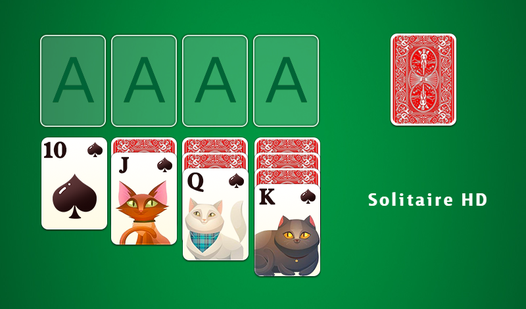
Solitaire HD is a sensible catalog starting point for familiar card-table play. Check its displayed rules before the first deal so you know which solitaire variant and stock settings are active.
How do you play Klondike and Spider, step by step?
Begin by identifying the variant, then make moves that reveal cards and preserve useful spaces.
- Read the rule panel to confirm the game. Identify Klondike or Spider, then check draw count, suit count, redeals, and undo rules.
- Scan every face-up card before moving. Find immediate builds, cards that can uncover hidden cards, and columns that may soon become empty.
- Expose a hidden tableau card. Prefer a move that turns over a face-down card because it adds a new option to the deal.
- Build legal descending sequences. Alternate colors in Klondike; in Spider, favor same-suit links even when a mixed-suit move is legal.
- Use empty columns deliberately. Place a useful King-led stack in Klondike or use the open space to rearrange sequences in Spider.
- Advance safe cards toward removal. Send suitable cards to Klondike foundations or complete a suited King-to-Ace run in Spider.
- Draw only after checking the tableau again. Use the Klondike stock when no useful table move remains, and delay a Spider stock row until the current layout is organized.
- Reassess after every reveal or deal. Newly exposed cards can change which move should come next, so avoid playing several automatic-looking moves without another scan.
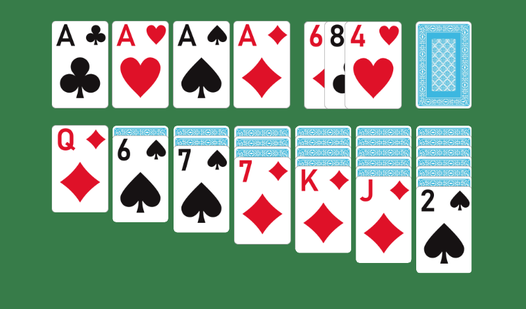
Zen Solitaire offers another catalog route into the genre. Its title suggests a relaxed presentation, but the in-game instructions remain the authority on its exact movement and scoring rules.
How do you win more often at Klondike and Spider?
You improve by valuing access and flexibility more than moves that merely look like progress.
In Klondike, uncovering tableau cards is usually the first priority. If two moves are legal, favor the one that reveals a card or opens a column for a useful King. Move Aces and low cards to the foundations when doing so is safe, but think before sending higher cards away. A foundation card may still be needed as a temporary tableau landing spot, especially in versions that do not allow foundation cards to return.
Watch the stock order. In draw-three Klondike, playing one waste card changes which cards become reachable on later passes. A move can therefore be useful even when it does not improve the tableau immediately. Avoid filling an empty column with the first King you see. A King that exposes several hidden cards is normally more productive than one attached to a nearly complete, already accessible stack.
In Spider, same-suit organization matters because mixed-suit chains cannot move together. A red eight on a black nine may be legal, yet it can pin the eight's lower cards until you find room to separate them. Use mixed suits as temporary scaffolding, not as a finished structure.
Empty columns are Spider's strongest working spaces. They let you split mixed sequences, reverse awkward placements, and combine suited fragments. Try to create one before the tableau becomes crowded, but remember that standard Spider will not let you deal a new stock row while a column is empty. Before dealing, consolidate sequences and inspect every possible reveal. The new row covers all ten columns and can break several promising builds at once.
Solitaire Lite is worth trying if you prefer a plainly labeled, lighter-looking entry point. Confirm the variant inside the game rather than assuming that every title containing Solitaire follows Klondike rules.
Is Spider Solitaire harder than Klondike?
Four-suit Spider is generally more complex than Klondike because it uses more cards and restricts which sequences can move together.
Klondike asks you to manage hidden cards, foundation timing, and stock access, but its alternating-color builds are easy to recognize. Spider creates longer dependencies across ten columns. A legal mixed-suit move can solve an immediate problem while making a later move much harder.
The answer changes with the settings. One-suit Spider removes most suit conflicts and is a friendly way to learn tableau management. Two-suit Spider adds meaningful planning without the full congestion of four suits. Draw-one Klondike with generous redeals is usually more forgiving than draw-three Klondike with limited passes. Difficulty labels make sense only after checking those rules.
What mistakes should beginners avoid?
The most common mistake in both games is making every available move without asking what it unlocks or blocks.
In Klondike, do not rush every card to the foundations, waste an empty column on an unhelpful King, or ignore a move that exposes a face-down card. Repeatedly cycling the stock without remembering its order also loses information. If the version has limited redeals, each pass should have a purpose.
In Spider, avoid building long mixed-suit chains just because they are legal. Do not deal a fresh row while useful rearrangements remain. Protect empty columns as working space instead of filling them casually. Also check the entire tableau after completing a suited run; its removal may expose a card or create a new empty column that changes the best next move.
Undo can teach rather than merely erase mistakes. Reverse a short sequence of moves, identify where flexibility disappeared, and try a different order. If unlimited undo is available, use it to study cause and effect instead of blindly testing every possibility.
What variants of Klondike and Spider can you play?
Klondike commonly changes its draw rule and redeal limit, while Spider changes the number of suits in play.
Draw-one Klondike reveals stock cards one at a time. Draw-three exposes every third card until earlier plays alter the order, which makes stock planning more demanding. Some versions allow unlimited stock passes; others limit them. Scoring and timed modes change how success is measured but do not replace the central foundation goal.
Spider's main levels are one suit, two suits, and four suits. One-suit mode still uses two full decks, but all cards behave as one suit for sequence building. Two-suit mode introduces conflicting groups. Four-suit mode uses the full standard restriction and demands much more temporary storage. Some related games loosen group-movement rules, so read the instructions instead of carrying assumptions from another app.
What are the best free solitaire games to try?
A good browser solitaire game states its variant clearly, makes legal moves readable, and explains settings that affect whether a deal can be solved.
Useful options include undo for learning, a restart button for replaying the same deal, legible card faces, and clear feedback when a stock action is blocked. Hints are best used after you have scanned the board yourself. A hint system may show a legal move without showing the strongest strategic move.
The catalog cards in this guide are starting points rather than claims that every title uses identical rules. Solitaire HD and Solitaire Lite suit players looking for plainly named entries. Zen Solitaire suggests a calmer theme. Solitaire Soviet offers a more distinctive theme once you are comfortable checking each game's own rule screen.
FAQ
Is Klondike the same game as classic Solitaire?
In the United States, Solitaire often means Klondike, especially in computer and browser game menus. Solitaire is actually a larger family that also includes Spider, FreeCell, Pyramid, and many other games.
Can every Klondike deal be won?
No. Winnability depends on the deal and the version's draw, redeal, and movement rules. A blocked game is not necessarily proof of a mistake, although changing the order of earlier moves may sometimes open a solution.
Can you move a mixed-suit sequence in Spider?
Under standard Spider rules, you can build single cards downward across suits, but you may move a multi-card sequence together only when it is descending and all one suit. Individual implementations may use looser rules.
Which game should a new player learn first?
Choose Klondike for its familiar one-deck layout and shorter board. Choose one-suit Spider if you want to practice planning long sequences without managing four competing suits.