
How to Play Spider Solitaire: Rules and Strategy

Spider Solitaire is a two-deck patience game where you build descending columns and remove complete, same-suit runs from King to Ace. Start by moving a card onto the next higher rank, uncover face-down cards whenever possible, and use empty columns to reorganize the tableau. You win after clearing all eight King-to-Ace runs.
The catch is that cards of different suits can usually be stacked together, but only a continuous same-suit sequence can move as one unit. That distinction makes Spider less about finding isolated legal moves and more about preserving access, creating workspace, and planning several moves ahead.
What are the rules of Spider Solitaire?
Spider Solitaire uses 104 cards arranged across ten tableau columns, and the objective is to remove eight complete same-suit sequences.
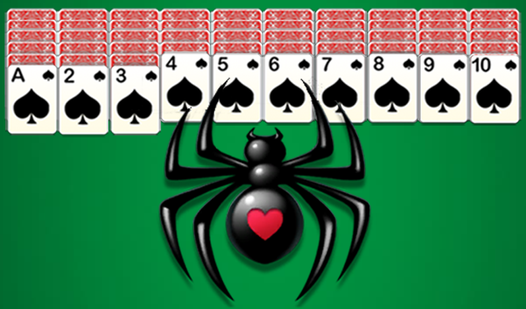
In a standard deal, the first four columns contain six cards each and the other six contain five. Only the top card of each column is face up. The remaining 50 cards form the stock, which supplies five later deals of ten cards.
The main rules are:
- Place a card on another card that is exactly one rank higher. For example, a 7 can go onto an 8.
- Suits do not have to match for a single-card move. A 7 of hearts may usually be placed on an 8 of clubs.
- Move multiple cards together only when they form an unbroken descending sequence of the same suit.
- Turn over a column's newly exposed face-down card immediately.
- Place any available card or valid movable sequence into an empty column.
- Deal one stock card onto every column when no empty columns remain. Most standard versions block a stock deal while a column is empty.
- Complete a King-through-Ace sequence in one suit to remove all 13 cards from the tableau.
Ranks do not wrap around: an Ace cannot support a King. Completed sequences normally disappear automatically, freeing space and bringing you closer to the eight required removals.
How do you play Spider Solitaire step by step?
Begin by exposing hidden cards and creating useful same-suit groups before you draw another row from the stock.
- Scan every column to identify options. Look for moves that uncover a face-down card, join matching suits, or open a short column.
- Move an exposed card onto the next higher rank. This creates access to the card beneath it and begins a descending build.
- Prefer matching suits when two moves are available. A same-suit 8-7 pair can later move together, while a mixed pair cannot.
- Reveal face-down cards as early as possible. Each revealed card increases the number of available moves and reduces uncertainty.
- Empty a column to create workspace. Use that open column to separate mixed stacks, reverse temporary moves, or relocate a long sequence.
- Combine same-suit fragments into movable runs. Join sections such as 10-9-8 and 7-6 only after checking what the move covers or releases.
- Deal from the stock only after exhausting productive tableau moves. The new row covers every column and may trap useful cards under awkward ranks.
- Finish King-to-Ace runs to remove them. Each completed suit clears 13 cards and creates much more room for the remaining work.
A legal move is not automatically a good move. Before placing a card, check whether you can retrieve it later and whether the destination blocks a more valuable hidden-card reveal.
How do you win at Spider Solitaire?
You win more often by maximizing mobility: expose hidden cards, protect empty columns, and build same-suit sequences without burying useful ranks.
Treat face-down cards as the main problem during the opening. If one move reveals a hidden card and another merely makes a neat visible stack, the reveal is usually stronger. New cards create options; tidy stacks can still leave the deal locked.
Empty columns are the most flexible resource in Spider. They let you park a card temporarily, break apart mixed-suit constructions, and transfer longer sequences. Do not fill an empty column permanently just because you can. A King is especially expensive to place there because nothing can be placed above the King to move it elsewhere. Commit a King only when it starts a useful same-suit build or when you have another route to clear the column.
Build in the same suit whenever the choice is reasonable. Mixed-suit stacks are legal storage, but every suit change acts like a joint that prevents the whole group from moving. If you must mix suits, place the interruption where it can be undone soon. Avoid burying a nearly complete run beneath a card whose destination is uncertain.
Before using the stock, inspect all ten columns again. Look for reversible moves, opportunities to merge two matching fragments, and ways to expose one more card. A stock deal adds ten blockers at once. It is most useful after you have organized the tableau so the incoming cards have several possible destinations.
Plan around rank availability as well. If several exposed 6s need 7s but every 7 is buried, avoid consuming the only accessible 7 in an inflexible stack. Spider rewards keeping several landing spots open rather than pursuing one perfect-looking column.
What beginner mistakes make Spider Solitaire harder?
The most common mistakes reduce future movement even though they produce legal or visually tidy stacks.
- Dealing too soon: The stock covers all ten columns, so unresolved problems become harder to reach.
- Mixing suits without an exit plan: A long descending stack may look useful but remain impossible to move as a unit.
- Wasting an empty column: Filling it with an immovable King removes your best tool for reorganizing cards.
- Ignoring alternative move orders: Moving the same two cards in a different sequence can reveal an extra card or preserve a landing space.
- Completing only the easiest visible stack: Local progress can bury the ranks needed by several other columns.
- Using undo without learning from it: Undo is helpful when you compare outcomes. Repeating random alternatives does not reveal why a position failed.
Pause when the tableau feels stuck. Trace which card is blocking the most useful move, then work backward to find the column or rank needed to release it.
Which Spider Solitaire difficulty should you choose?
Choose one suit to learn movement, two suits for a strategic challenge, and four suits for the full version.
In one-suit Spider, every descending sequence is also a same-suit sequence. That makes groups easier to move and lets you concentrate on exposing cards, managing empty columns, and timing stock deals. It is the best setting for learning the game's structure.
Two-suit Spider introduces meaningful suit conflicts without making the tableau as restrictive as the full game. You must decide when a mixed stack is acceptable and how to preserve access to both suits. This is a good next step once one-suit deals feel routine.
Four-suit Spider demands much more planning. Legal descending moves are plentiful, but fully movable sequences are harder to assemble. Empty columns and move order become critical, and some attractive short-term moves can damage the position several deals later.
What are the best Spider Solitaire games to play free?
The best free Spider Solitaire game is one whose layout is easy to read, whose controls make moves unambiguous, and whose difficulty matches what you want to practice.
Spider Solitaire HD is a sensible starting point if visual presentation is your priority. A clearly displayed tableau helps you distinguish ranks, inspect suit changes, and spot face-down-card opportunities. Spider Solitaire Classic is the natural choice when you want the familiar format without choosing a specialized theme.
Spider Solitaire 3 Modes is the most relevant catalog option for progressing through difficulty levels. Start with one suit, apply the same decision process in two suits, and attempt four suits once you can preserve empty columns consistently.
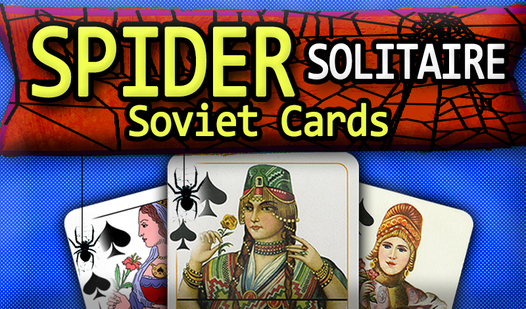
Spider Solitaire Soviet Cards offers a themed alternative for players who want a different deck style while practicing the same core genre. With any visual theme, choose cards whose suits and ranks remain easy for you to distinguish across ten crowded columns.
FAQ
Can you put any card in an empty column in Spider Solitaire?
Yes. Standard rules allow any exposed card or valid same-suit movable sequence to enter an empty column.
Can mixed-suit sequences be moved together?
Usually not. You can build downward across different suits, but a multi-card group must normally be entirely in one suit to move together.
Do you have to fill empty columns before dealing from the stock?
Yes in most standard versions. You must place at least one card in every empty column before dealing a new row.
Is every Spider Solitaire deal winnable?
Not necessarily. Random deals may not be guaranteed solvable, and available features or deal-generation rules can differ between versions.