
How to Play FreeCell: Rules, Moves, and Strategy

FreeCell is a solitaire card game in which all 52 cards are visible from the start. Build four foundations from ace to king by suit, arrange tableau cards in descending alternating colors, and use four temporary free cells to unlock blocked cards. You win by moving the entire deck to the foundations.
What are the rules of FreeCell?
The basic rule is simple: uncover useful cards by rearranging the tableau, then move every suit to its foundation in ascending order.
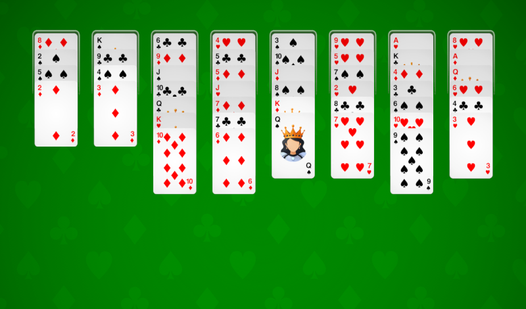
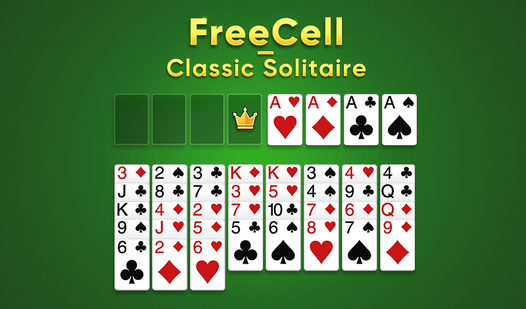
A standard game uses one 52-card deck. All cards are dealt face up into eight tableau columns. The first four columns receive seven cards each, while the other four receive six. Because there is no hidden stock or face-down layer, you can inspect the whole puzzle before making a move.
Above the tableau are four free cells and four foundations. Each free cell can hold one card. A foundation begins with an ace and continues upward in the same suit: ace, 2, 3, and so on through the king.
In the tableau, place cards in descending rank while alternating colors. A black 8 can receive a red 7, for example, but not a black 7 or any 9. Only an exposed card at the end of a column can be moved. An empty tableau column can receive any exposed card or a movable packed sequence.
You may move an ordered sequence only when enough free cells and empty columns exist to reproduce that move one card at a time. This limit is a defining part of FreeCell strategy. Some browser versions perform the intermediate moves automatically, while relaxed variants may allow longer sequences.
How do you play FreeCell step by step?
Start by studying the complete deal, then create space without trapping the low cards needed for your foundations.
- Scan the tableau to find key cards. Locate all aces and 2s, then note which cards block them. This gives your opening moves a purpose.
- Release accessible aces. Move an exposed ace to its foundation so it no longer occupies working space.
- Build alternating runs. Place lower cards on opposite-colored higher cards to expose the next card in a useful column.
- Use a free cell temporarily. Park one blocking card there only when doing so reveals something valuable or completes a planned sequence.
- Open a tableau column. Emptying a column creates a powerful storage space that can help you rearrange much longer runs.
- Move packed sequences legally. Transfer an alternating descending run when your available cells and columns can support the move.
- Advance foundations carefully. Send low cards upward when safe, but retain a card if it is still needed to organize the tableau.
- Clear the remaining columns. Once every suit is sufficiently developed and no essential card is trapped, move the final cards to the foundations.
Do not treat these as eight isolated actions. FreeCell is a planning game: before moving a blocker, decide where that card will go afterward. A move that exposes an ace but fills your final free cell can still make the position worse.
How many cards can you move at once in FreeCell?
The maximum movable sequence depends on how many free cells and empty tableau columns you can use as temporary storage.
Under common standard rules, the capacity is calculated as (empty free cells + 1) × 2^empty columns. Count only empty columns available as temporary buffers. If the destination is itself an empty column, it cannot also be counted as a buffer for that move.
For example, two empty free cells and one separate empty column let you move up to six properly ordered cards: (2 + 1) × 2 = 6. With no empty columns, those same two cells support only three cards. This is why an empty column is much more valuable than a single free cell.
The sequence must already descend by rank and alternate colors. Capacity does not let you move a disorganized pile. Interfaces may hide the intermediate steps behind one drag, but the underlying storage limit still matters in standard FreeCell.
How do you win at FreeCell more often?
You win more consistently by protecting maneuvering space, freeing low cards early, and planning several moves beyond the immediate opening.
Begin with a full-board scan. Look for aces and 2s buried near the top of long columns, but also identify the cards needed to reach them. If a red 5 blocks an ace, you may first need an available black 6. Finding that dependency before moving prevents wasted free cells.
Treat free cells as active workspace, not permanent parking. Four occupied cells reduce your movement capacity to one card unless you have empty columns. Try to keep at least one cell open, and prefer moves that empty a cell again within the next few turns.
Prioritize an empty column when the route is safe. A vacant column can temporarily hold a king, a single blocker, or a whole legal sequence. Its multiplying effect on sequence capacity often makes it the turning point of a difficult deal. Do not immediately fill it with a card that cannot be moved again.
Build balanced sequences. If every useful black card becomes buried under red cards, you may lose the landing spots needed for another column. Check both colors and several ranks before extending a long run.
Foundation moves are usually helpful, but not automatically correct. An early 5 or 6 may still be needed as a tableau landing card. A practical safety test is to compare the opposite-colored foundations: pushing one suit far ahead can remove cards required to organize lower cards of the other colors.
Finally, favor reversible moves. Moving a card onto a foundation is normally permanent, while moving it to an open tableau position leaves more options. When two moves expose the same target, choose the one that preserves more empty cells, columns, and legal destinations.
What mistakes do new FreeCell players make?
The most common mistakes use scarce storage without a clear plan or solve one small problem while creating a larger blockage.
- Filling every free cell: This leaves no simple way to separate or transport a sequence.
- Moving every available card to a foundation: A medium-ranked card may still be required as a landing spot in the tableau.
- Creating a long run too early: The run may look organized but can bury the exact card needed elsewhere.
- Wasting an empty column: Parking an immovable king there can remove your strongest rearrangement tool.
- Ignoring color balance: Building only around one color can leave no legal destination for exposed cards of the other color.
- Making moves without an exit: Before using a cell, know how you expect to empty it again.
Undo can help you learn from a failed line, but it should support analysis rather than random trial. Return to the decision that caused the blockage and test a different order of moves.
Is every FreeCell game solvable?
No, not every possible FreeCell arrangement is solvable, although a large majority of standard deals can be won with correct play.
FreeCell depends far less on luck than solitaire games with hidden cards because the full layout is visible. Still, a deal can contain dependencies that cannot be untangled with the available cells and columns. Browser games may also use different deal generators, relaxed movement rules, or curated layouts, so their difficulty and solvability can vary.
If a position appears impossible, inspect the opening again before abandoning it. Many losses begin with a workable deal and an inefficient move order. Focus on which move first consumed a free cell, blocked an empty column, or sent a useful card to a foundation too soon.
What FreeCell variants can you play?
FreeCell variants change the building rule, tableau layout, storage spaces, or the number of cards that may move together.
Baker's Game resembles FreeCell but builds tableau sequences by suit instead of alternating colors, which makes compatible landing spots scarcer. Eight Off provides more reserve cells and commonly uses same-suit building. Seahaven Towers changes the tableau arrangement and also emphasizes suited sequences.
Some digital versions use relaxed supermoves, allowing an entire valid run to move without enforcing the temporary-space calculation. Others combine FreeCell ideas with Spider-style sequence building or clearing. These hybrids can be enjoyable, but check the in-game rules before assuming that standard FreeCell capacity or foundation rules apply.

What are the best FreeCell games to play free?
The best free FreeCell game has readable cards, predictable controls, clear movement feedback, and rules that match the style you want to practice.
For learning the standard game, choose a classic-focused version and verify how it handles multi-card moves. Hints are useful when they explain a legal move, but a suggested move is not always the strongest strategic choice. Undo is especially valuable for comparing two move orders and understanding why one preserves more space.
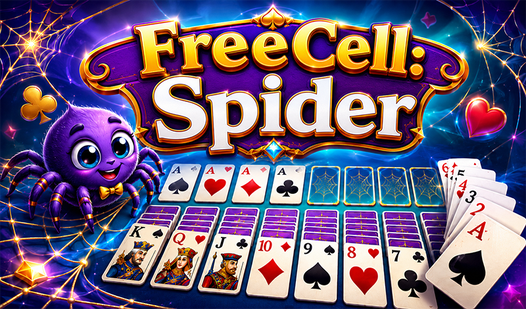
Solitaire FreeCell HD offers a dedicated FreeCell entry for practicing the core layout and foundation goal. FreeCell Pure Classic is another natural choice for repeated traditional sessions. If you want a variation on the formula, FreeCell Spider provides a hybrid direction rather than identical standard play.
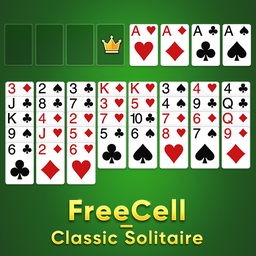
FreeCell Classic Solitaire gives you another standard-themed option, which is useful because interface clarity can affect how easily you read long columns and spot alternating sequences. Try more than one version, then keep the one whose controls make legal moves and blocked moves easy to distinguish.
FAQ
What is the goal of FreeCell?
Move all 52 cards to four foundations, building each suit from ace through king.
Can you move a stack of cards in FreeCell?
Yes. The stack must descend in alternating colors, and standard rules require enough empty free cells and tableau columns to complete the transfer through legal single-card moves.
Can any card go into an empty FreeCell column?
Yes. Any exposed card can enter an empty tableau column, as can a legal sequence within your movement capacity. A free cell itself can hold only one card.
Is FreeCell easier than regular solitaire?
FreeCell gives you more information and control because every card is visible, but difficult deals require deeper planning. It is often less luck-dependent than Klondike, not automatically easy.