
How to Play Solitaire: Rules, Setup, and Strategy

Solitaire usually means Klondike, the card game where you arrange seven tableau columns in descending order with alternating colors, uncover hidden cards, and move every card to four suit foundations from ace through king. Start by playing available aces and building useful sequences, but focus first on revealing face-down cards. You win when all 52 cards reach the foundations.
The name Solitaire covers many single-player card games, so an online version may use slightly different rules. This guide focuses on Klondike, the familiar layout included with many computers and browser game collections. Before starting, check whether the game uses draw-one or draw-three cards and whether the stock can be recycled without a limit.
What are the rules of Solitaire?
The basic rule of Klondike Solitaire is to rearrange the tableau in descending, alternating-color sequences while building four foundations upward by suit.
A standard game uses one 52-card deck. The tableau contains seven columns. The first column has one card, the second has two, and so on through the seventh column. Only the top card of each column begins face up. The remaining 24 cards form the stock.
The four empty foundation spaces are normally placed above the tableau. Each foundation begins with an ace and continues upward in the same suit: ace, 2, 3, and so on until the king. Completing all four foundations accounts for every card in the deck and wins the game.
On the tableau, cards must be placed in descending rank and alternating colors. A black 8 can receive a red 7, for example, but not a black 7 or any 9. You may move a correctly ordered face-up sequence as one unit. If moving cards exposes a face-down card, turn that card face up immediately.
Only a king, or a valid sequence headed by a king, can enter an empty tableau column under standard rules. This makes empty columns powerful but also easy to misuse. An empty space that you cannot fill may leave you with fewer places to organize cards.
Cards from the stock are turned into a waste pile. In draw-one games, one card becomes available at a time. In draw-three games, cards are dealt from the stock three at a time and usually only the top exposed waste card can be played. Rules for recycling the waste back into the stock differ between games.

How do you play Solitaire step by step?
You play Solitaire by opening the tableau, creating legal alternating-color runs, using the stock when necessary, and transferring cards to their foundations.
- Inspect the face-up cards to find immediate moves. Look for aces, cards that can be stacked, and moves that will expose a hidden card.
- Move available aces to the foundations. This opens the foundation piles and may free useful tableau cards, though later foundation moves should be considered more carefully.
- Build downward with alternating colors. Place each lower card on an opposite-color card one rank higher, such as a black 6 on a red 7.
- Move complete sequences to expose covered cards. Transfer a valid run when doing so reveals a face-down card or creates a strategically useful space.
- Turn over newly uncovered cards. Revealing hidden cards expands your choices and is usually the most important source of progress.
- Fill empty columns with kings deliberately. Prefer the king or king-led sequence that releases the most hidden cards or creates access to a needed rank.
- Draw from the stock when the tableau has no productive move. Play useful waste cards onto the tableau or foundations, then continue through the stock according to the selected draw rules.
- Build foundations in suit order. Place the 2 of a suit on its ace, the 3 on the 2, and continue upward without skipping ranks.
- Recheck the board after every reveal. A newly exposed card can unlock several moves, so do not keep drawing automatically.
- Finish by transferring the remaining ordered cards. Once every tableau card is visible and the stock is accessible, move the suits through queen and king to complete all foundations.
There is no need to race unless the game uses a timer or score bonus. A deliberate scan of the tableau often prevents a move that looks harmless but blocks a needed card.
How do you win at Solitaire more often?
You win more often by maximizing access to hidden cards, preserving useful choices, and planning stock plays instead of automatically taking every legal move.
Reveal face-down cards before chasing foundation progress
A move that uncovers a tableau card is usually more valuable than one that merely adds a card to a foundation. Hidden cards restrict the board and may contain the rank or suit needed to continue. When choosing between two possible moves, favor the one that reveals a card from a taller column.
This is a priority, not an absolute command. Sometimes you must build a foundation to free a card or create a tableau move. The useful question is what the move unlocks, not simply where the card goes.
Keep the foundations reasonably balanced
Building one suit far ahead can remove cards that are still needed as supports in the tableau. Suppose a red 5 is sent to a foundation while a black 4 remains buried. You may later need that red 5 to hold the black 4. Some digital games let you return foundation cards to the tableau, but others do not, so check the local rules before relying on that option.
Balanced foundations also reduce the chance that low cards of one color become unavailable while the opposite color still needs them. Aces and 2s are usually safe to move. Higher cards deserve a quick board check first.
Treat an empty column as a resource
Clearing a column can be a major breakthrough because it lets you relocate a king and uncover more cards. It is not automatically useful, however. Before emptying a column, identify the king that will fill it. Moving an unhelpful king into the space can lock the column for several turns.
When two kings are available, compare what lies beneath them and which color sequence each king can accept. Choose the move that opens access rather than the move that merely makes the tableau look tidy.
Choose between equivalent moves carefully
If a red 7 can be placed on either of two black 8s, examine both source and destination columns. Prefer a move that reveals a hidden card, empties a column at the right time, or keeps another useful landing spot free. These small choices often separate a solvable position from a stalled one.
Avoid moving cards sideways without a purpose. Rearranging the same visible cards may change the board without increasing access to anything new.
Learn the order of the stock
In draw-three Solitaire, stock management is a large part of the puzzle. Playing one waste card changes which cards will be exposed on the next pass. Remember the location of blocked cards and consider whether taking the current card will make a needed card reachable later.
In draw-one games, inspect the full stock before committing to marginal moves if the rules permit another pass. Knowing which kings, aces, or missing ranks remain in the stock helps you decide whether to clear a column or preserve a tableau card.
No strategy guarantees every random deal. Rule settings affect difficulty, and some arrangements cannot be completed under strict play. Good decisions still matter because they prevent avoidable dead ends and solve more of the deals that offer a winning route.
What are the most common Solitaire mistakes?
The most common mistakes are moving cards automatically, filling empty columns too soon, and ignoring how a move changes access to hidden or stock cards.
- Sending every available card to a foundation: A legal foundation move can remove a card needed to build a tableau sequence. Check which lower opposite-color cards remain first.
- Taking the first legal move: Two moves may use the same rank but produce very different positions. Look for reveals, empty columns, and future landing spots.
- Moving a king without a follow-up plan: A king occupies an empty column permanently until its entire sequence can be moved. Make sure it opens something useful.
- Ignoring the longest covered columns: Easy moves among short columns can feel productive while the important cards remain buried in columns six and seven.
- Cycling through the stock too quickly: In draw-three games, careless waste plays can change the dealing rhythm and hide a needed card on later passes.
- Assuming every browser version has identical rules: Draw count, stock passes, hints, undo behavior, scoring, and foundation-to-tableau moves may differ. Read the game panel before treating an action as irreversible.
Using undo to study a position is also useful while learning. Rather than repeatedly clicking until something works, identify why the first line failed and what information should change the decision.
What variants of Solitaire can you play?
The main Solitaire variants change the layout, building rules, stock behavior, or even the central matching mechanic.
Klondike is the standard starting point. Draw-one Klondike makes stock cards easier to access and is generally more approachable. Draw-three uses the same tableau rules but makes the order of the stock more important.
Spider uses multiple tableau columns and asks you to assemble descending sequences, ideally in the same suit, before removing complete king-to-ace runs. FreeCell deals every card face up and provides temporary holding cells, so its challenge centers more on planning than hidden information. Pyramid removes exposed pairs whose ranks total 13. TriPeaks clears cards one rank above or below the current waste card.
Catalogs may also include hybrids that borrow the language or layout of Solitaire while using pair matching, words, or other objectives. Do not assume that skills transfer perfectly: first identify the win condition, which cards are playable, and what can fill an empty space.
What are the best Solitaire games to play free?
The best free Solitaire game is one with readable cards, clear legal-move feedback, responsive controls, and rule settings that match the challenge you want.
For learning Klondike, choose a version with an undo button and draw-one rules. Undo makes cause and effect easier to understand, while draw one reduces the amount of stock-order planning required. Hints can teach the controls, but they are not always strategic recommendations. A hint system may identify any legal move even when another move is better.
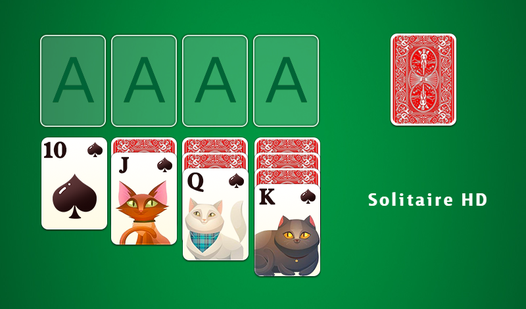
Solitaire HD is a sensible catalog starting point if you want a title framed around the familiar game. Check its in-game rules for the available draw mode and stock limits before applying a strict strategy.
Zen Solitaire may suit players looking for a calmer presentation. The title describes its style rather than proving a specific ruleset, so confirm whether it follows standard Klondike rules once it loads.
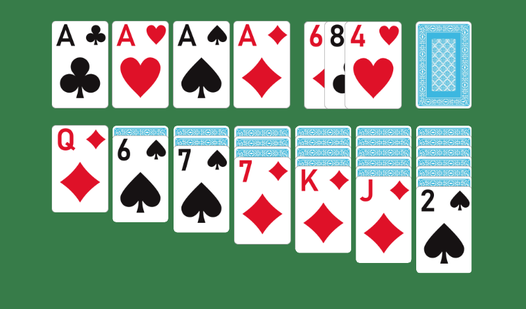
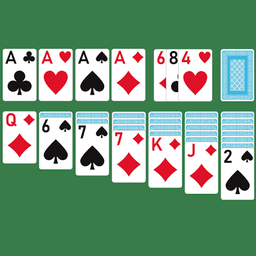
Solitaire Lite offers another direct entry from the catalog. Use the opening layout to identify the variant: seven increasing tableau columns indicate Klondike, while a different deal may require different tactics.
Solitaire Pairs is better treated as a variation after you understand classic tableau building. Pair-based versions usually emphasize matching rather than foundation construction, so follow the displayed objective instead of assuming standard Klondike moves.
The most useful first game is not necessarily the one with the most visual effects. Prioritize cards that remain distinct at your screen size, controls that do not cause accidental moves, and rules that are explained before play. Once basic decisions feel natural, switch to draw-three or a different variant for a harder puzzle.
FAQ
How many cards do you deal for Solitaire?
Klondike uses all 52 cards. Twenty-eight are dealt into seven tableau columns, and the other 24 form the stock.
Can you put any card in an empty space in Solitaire?
Under standard Klondike rules, only a king or a correctly ordered sequence beginning with a king can fill an empty tableau column.
Do you have to move every ace immediately?
Moving an exposed ace is usually safe and starts a foundation. Higher foundation cards require more caution because they may still be needed in the tableau.
Is Solitaire mostly luck or skill?
Both matter. The deal and rule settings determine what is possible, while careful reveals, foundation timing, column management, and stock planning determine whether you find an available winning route.