
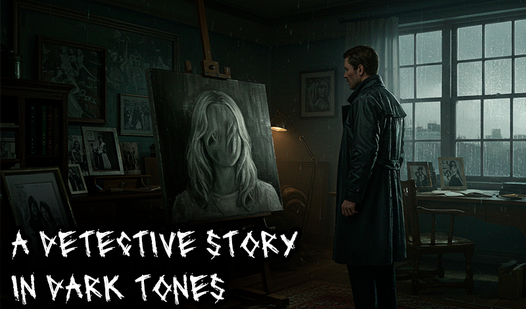
A Detective Story in Dark Tones Walkthrough and Tips

To complete A Detective Story in Dark Tones, inspect every scene carefully, record the clues you discover, and identify which action unlocks the next part of the investigation. Your goal is to reconstruct the chain of events, and the central rule is to connect visual details with dialogue and established facts. If progress stops, return to the latest clue and recheck the places related to it.
How do you complete A Detective Story in Dark Tones?
The walkthrough depends on searching for clues in a consistent order, testing the connections between them, and reading every available line carefully.
Do not try to guess the final solution immediately. Start by separating what the game has confirmed from what you merely suspect. Identify the characters involved, the events that have already occurred, the visual details receiving attention, and the questions that remain unanswered. This distinction prevents a promising theory from turning into a chain of unsupported guesses.
Inspect each new scene in the same order. You might begin with the large objects in the center, then check the edges, background, and foreground. Move on to characters and written information afterward. A systematic scan works better than random clicking, especially in dark locations where an interactive detail can blend into the environment.
When you find a clue, ask what it relates to. It may concern a location, a character, the order of events, or a contradiction in somebody's account. If the game lets you revisit scenes or conversations, return with a specific question instead of searching blindly. Ask which detail has gained a new meaning or whose story no longer matches the known facts.
Do not rush through the text. A line in a detective story often serves two purposes: it advances the plot and hints at the next action. Watch for repeated words, unusually precise phrasing, abrupt changes of subject, and differences between what a character says and what the scene shows.
How do you play step by step?
To keep the investigation moving, handle each episode as one cycle of observation, evidence gathering, theory testing, and result checking.
- Survey the scene and establish your bearings. Locate the characters, large objects, and possible exits first, so small details do not distract you from the overall situation.
- Check interactive areas and collect clues. Move through the screen deliberately rather than clicking at random. If the cursor or interface reacts to an object, inspect that interaction completely.
- Read every new message and clarify the objective. After a discovery, check whether the dialogue, scene description, or available goal has changed. A new line often tells you what needs to happen next.
- Connect the clue to a character or event. Ask what the detail confirms, what it contradicts, and why it became relevant at this moment. The result should be a working theory rather than a pile of unrelated discoveries.
- Revisit related objects and unlock the next event. Recheck only the places whose meaning changed after the new information. This avoids an endless tour of the entire scene.
- Verify the action order and fill any gap. If a sensible idea does not work, make sure the required setup has been completed. An event may become available only after you inspect the relevant detail or finish a conversation.
- Support the theory with facts and advance the case. Choose the conclusion that explains the known evidence with the fewest assumptions. A successful choice should produce new dialogue, a scene, another clue, or a visible change in the episode.
- State what changed and repeat the cycle. Before moving on, summarize the new discovery in one sentence. This keeps the plot clear and makes later contradictions easier to notice.
How do you find clues without missing important details?
The most reliable method is to divide the screen into zones and inspect them in order without trying to solve the entire mystery at the same time.
On a dark or detailed background, search for visual irregularities instead of one specific object. Look for an unusual outline, a different shade, a repeating shape, a small light source, or something placed with suspicious prominence. Do not treat every decorative mark as evidence, however. A useful interaction is usually confirmed by interface feedback, a changed description, or new information.
Recheck a scene after an important conversation. Something that previously looked like background decoration may become relevant after a character mentions a connected subject. That does not mean clicking everything again. Return to the areas that logically match the new information.
Pay attention to negative evidence as well. A missing detail, a blocked route, or the inability to perform an obvious action can reveal something. If an expected object is absent, ask how that changes your reconstruction. In detective reasoning, a meaningful absence can matter more than a conspicuous discovery.
If the dark palette is straining your eyes, take a short break and return with a fresh view. Avoid raising the brightness until subtle shades disappear, and do not keep changing the browser zoom during your search. A stable image makes it easier to remember which areas have already been checked.
What should you do when the walkthrough stops progressing?
If the investigation refuses to move forward, there is usually an unfinished connection between the latest clue, its scene, and an available action.
First identify the point after which nothing changed. Do not reconstruct the whole story at once. Find the last confirmed sign of progress, such as a new conversation, a discovered detail, an opened area, or a theory the game recognized. Then check five common causes:
- The inspection is incomplete. Open the latest clue again and make sure you have viewed every available state, part, or explanation.
- A conversation is unfinished. Return to the available characters. New evidence may add a line to an existing dialogue instead of creating a separate notification.
- A logical connection is missing. Compare the new detail with earlier facts. Look for a shared character, location, time, or contradiction rather than a superficial resemblance.
- The order is wrong. Inspect the supporting object before selecting a conclusion or performing the main action. The correct option may remain unavailable until the game registers its justification.
- A screen area remains unchecked. Inspect the edges, the background behind larger objects, and the spaces near interface elements. Follow a route so you do not repeatedly search one area while skipping another.
If those checks fail, describe the current objective in your own words. Focus on the fact that needs to be proven, not the button that needs to be pressed. List the available actions and keep only those capable of producing that proof. This turns a vague dead end into a short logic problem.
Which mistakes most often block progress?
Players are usually stopped by random searching, a premature conclusion, or a missed change in a familiar scene rather than by an exceptionally difficult puzzle.
- I never click without a route. I divide the scene into left, center, and right sections before checking the background and foreground. This makes it clear which areas have been searched and where a clue may still remain.
- I reread the latest important line after finding evidence. A specific name, location, or phrase often points toward the next place to inspect. Continuing immediately can bury that connection under newer details.
- I test a theory for contradictions, not just attractive coincidences. One matching clue proves very little. A strong explanation needs to cover several facts without conflicting with anything the game has already confirmed.
- I change one part of an attempt at a time. If an action fails, I adjust the order, object, or selected connection separately. Changing everything at once turns reasoning into random guessing and hides which part of the idea was correct.
Rushing is another common problem. Skipping dialogue may save a few seconds, but it often leads to another complete search of the scene. Text is part of the core detective mechanic, so it deserves the same attention as the visual environment.
How do you solve logic puzzles without random guessing?
A logic puzzle becomes easier when you restate its conditions in plain language, eliminate impossible options, and choose an answer only after that process.
Begin with the strongest restrictions. A confirmed fact outweighs a suspicion, while a direct contradiction is more useful than a weak match. If an option violates even one reliable condition, remove it. Do not rescue an appealing theory with extra assumptions that the story never supplied.
When reconstructing a timeline, search for dependencies. If one action could occur only after another, you have a relative order even without an exact time. Combine several of these relationships into a chain, then check whether the proposed version can still fit.
In text-based problems, pay close attention to phrasing. A character may describe something they saw, something they heard, or something they merely assume. Those statements have different levels of reliability. You should also distinguish between a lack of evidence and evidence of absence. A character failing to notice something does not prove it was never there.
Before confirming an answer, explain it briefly to yourself. Which two or three facts make this option stronger than the alternatives? If the explanation consists only of a hunch, return to the conditions. If it relies on confirmed connections and resolves the main contradictions, the choice is probably justified.
FAQ
Can you complete A Detective Story in Dark Tones without hints?
Yes. Search scenes along a fixed route, reread new dialogue, and connect every clue to a character, location, or event. Use a hint only when a systematic check still fails to reveal the unfinished interaction.
What should I check first when I get stuck?
Open the most recent clue, repeat the conversation connected to it, and inspect the place whose meaning may have changed. Do not search the entire scene again before checking this short chain.
Do I need to click every object?
No. Random clicking makes it harder to remember inspected areas and obscures the logic of the investigation. Divide the scene into sections, watch for interface feedback, and revisit objects when related information appears.
How can I tell whether a theory is correct?
A strong theory explains several confirmed facts, requires no invented circumstances, and resolves the major contradictions. Testing it should usually produce a clear result, such as new text, another clue, a scene, or an available action.