
What Is a Nonogram? Rules, Strategy, and Free Games

A nonogram is a logic puzzle in which number clues tell you which squares to fill in a grid. Each number gives the length of a consecutive block in its row or column, and separate blocks need at least one blank square between them. Start with lines whose clues nearly fill the available space, mark guaranteed cells, then use crossing clues to reveal a hidden pixel picture without guessing.
What are the rules of a nonogram?
The goal is to fill every required square and mark every empty square according to the clues beside the grid.
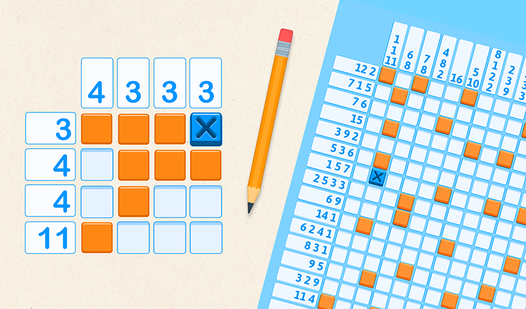
Each row has a sequence of numbers, as does each column. A clue of 5 means that the line contains a run of five adjacent filled cells. A clue of 3 1 means that it contains a block of three cells followed later by a single filled cell. There must be at least one empty cell between those blocks, but there may be several.
The clues preserve the order of the blocks. If a row is labeled 2 4, the two-cell block must appear before the four-cell block. The clues do not reveal the exact starting positions, so you determine them by combining information from rows and columns. A line is complete only when all its blocks and all remaining empty cells have been identified.
Most nonograms use one color. Filling the correct cells eventually produces a recognizable pixel image, but the image is a result of the logic rather than a reliable solving hint. Trying to draw what you expect often creates mistakes.

How do you play a nonogram step by step?
Solve a nonogram by finding certain cells first, recording confirmed blanks, and repeatedly transferring information between rows and columns.
- Read the grid dimensions to understand the available space. A clue of 8 behaves very differently in a ten-cell line than in a twenty-cell line.
- Scan for complete lines to gain immediate information. If a ten-cell row has a clue of 10, fill the whole row. If a line has no filled blocks, mark every cell as empty.
- Use overlap to identify guaranteed filled cells. Place a large block as far left as possible, then imagine it as far right as possible. Any cells covered in both positions must be filled.
- Mark completed block boundaries to prevent accidental extensions. Once a block has reached its required length, place an empty mark immediately before and after it when those cells exist.
- Check the crossing lines to create new deductions. Every newly filled or empty cell changes the possibilities in its column or row.
- Fit remaining clues into reduced spaces to locate more blocks. Empty marks divide a line into smaller segments. A block must fit wholly inside one suitable segment.
- Recount each finished line to catch contradictions early. Confirm that the block lengths, order, and separating spaces match the clue exactly.
- Repeat the row-column cycle until the grid is resolved. If progress stops, rescan every incomplete line instead of making a speculative mark.
Use distinct controls or symbols for filled and empty cells. An empty mark is not decoration: it carries as much logical information as a filled square and prevents you from reconsidering impossible positions.
How do nonogram clues work?
A clue describes the lengths and order of all filled groups in one line, but it leaves their exact positions for you to deduce.
Suppose a ten-cell row has the clue 6. The six-cell block could begin in positions one through five. Its leftmost placement covers cells 1 to 6, while its rightmost placement covers cells 5 to 10. Cells 5 and 6 appear in every possible placement, so they are safe to fill.
For multiple clues, include the mandatory gaps when calculating space. A clue of 3 2 needs at least six cells: three filled cells, one separating blank, and two more filled cells. In a six-cell line, its arrangement is fixed. In a longer line, some uncertainty remains, but confirmed cells and blanks from crossing lines will narrow it.
Completed blocks also reveal emptiness. If you have already found a run of exactly four cells for a clue of 4, the cells touching its ends cannot be filled. Marking those boundaries is one of the fastest ways to open new deductions elsewhere.
How do you win at a nonogram without guessing?
You win consistently by tracking what must be true in every legal arrangement rather than choosing what merely looks likely.
Begin with high-information lines. Long clues, nearly full lines, and lines with little unused space tend to produce overlap. For a line of length L with blocks totaling B and N separate blocks, the minimum required space is B + N - 1. The smaller the difference between L and that minimum, the more constrained the line is.
After placing part of a block, test its possible reach. If a filled cell belongs to a five-cell block, consider every five-cell placement that could include it without crossing a confirmed blank. Cells common to all valid placements are certain. Cells beyond every possible endpoint are empty.
Treat empty marks as walls. They divide a row or column into independent segments and may show that a clue cannot fit in one of them. If only one segment can hold the largest remaining block, you have found its region even if its exact position is not yet known.
Work in short cycles. Make one or two deductions in a row, immediately inspect the affected columns, and then return to the rows. This reduces oversight and makes the source of a contradiction easier to find. If the puzzle appears to require guessing, first look for an unmarked boundary, an overlooked overlap, or a segment that is too short for its remaining clue.
What beginner mistakes make nonograms harder?
Most beginner errors come from treating uncertain cells as facts or failing to record confirmed empty space.
- Extending a block too far: Stop as soon as a run reaches its clue length, then close its boundaries with empty marks.
- Ignoring clue order: A later block cannot jump ahead of an earlier one, even if both lengths fit the available cells.
- Combining separate blocks: Different clue numbers require at least one empty cell between their runs in a standard one-color puzzle.
- Solving from the picture: A shape that resembles an animal or object can tempt you to fill symmetrical or visually plausible cells unsupported by clues.
- Forgetting finished lines: Verify and close every leftover cell after all required blocks in a line are complete.
When a contradiction appears, do not erase the entire board. Trace the affected row and column back to the most recent uncertain deduction. Check block length, order, boundaries, and crossed empty marks. A systematic correction is faster than restarting.
What types of nonogram puzzles are there?
The main variants change the grid size, use multiple colors, or divide play into shorter puzzle formats while preserving clue-based deduction.
Standard black-and-white nonograms use filled and empty squares. Color nonograms assign clues to colors; depending on the ruleset, differently colored blocks may be allowed to touch without an empty square. Always check the instructions before applying the usual separation rule.
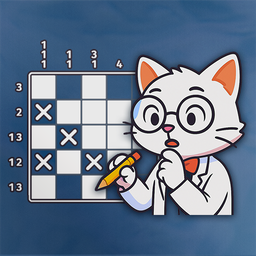
Small grids are good for learning because you can see the interaction between rows and columns quickly. Larger grids contain longer clue sequences and more partially solved regions, so careful marking becomes essential. Some digital versions add error indicators, hints, timers, or automatic completion marks. These features change the interface, not the underlying logic.
What are the best nonogram games to play free?
A good free nonogram game makes both filled and empty marks clear, keeps clues readable, and lets you correct input without fighting the interface.
For your first puzzle, choose a modest grid with simple one-color clues. Practice overlap, block boundaries, and row-column cycling before moving to larger boards. An optional error check can help while learning, although solving with mistakes hidden develops stronger verification habits.
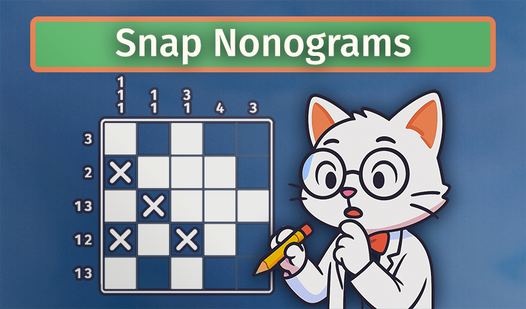
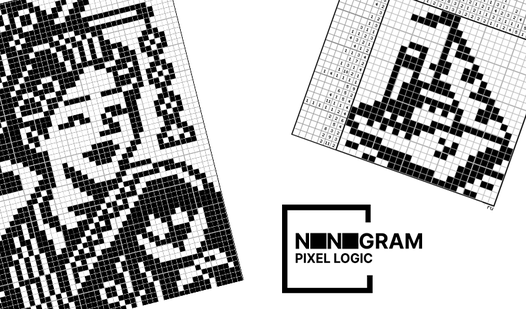
The catalog games linked here provide several ways to practice the same core puzzle style. Nonogram is a direct place to begin, while Classic Nonogram is suited to practicing the familiar clue format described in this guide. Snap Nonograms offers another entry into the genre. Nonogram Pixel Logic is a useful next stop when you want another set of browser-based logic grids. Interface details may differ, so check each game's controls before marking the board.

FAQ
Are nonograms the same as Picross?
They use the same core idea: number clues identify groups of filled cells that form a pixel picture. Picross is a common name associated with this puzzle format, while nonogram is the broader generic term.
Do you ever have to guess in a nonogram?
A well-constructed nonogram should normally be solvable through deduction. If you seem stuck, inspect overlaps, completed block boundaries, clue order, and spaces too short for the remaining blocks before guessing.
Can a nonogram have more than one solution?
Yes, an ambiguous or poorly designed puzzle can permit multiple valid grids. A good published puzzle normally has one solution that follows logically from its row and column clues.
What does a zero clue mean in a nonogram?
It means the row or column contains no filled cells, so every square in that line can be marked empty. Some games show 0, while others leave the clue area blank.