
How to Play Minesweeper: Rules, Strategy, and Tips

Minesweeper is a logic game played on a grid of hidden cells. Some cells contain mines; the rest are safe. Open a safe cell to reveal a number showing how many mines touch it, then use those numbers to locate the mines. You win by opening every non-mine cell without detonating a mine. Flags help you track suspected mines, but careful deduction wins the game.
A typical game begins with a covered board, a mine counter, and a timer. Choose an easy board while learning. Your first move may open one cell or clear a larger empty area, depending on the version. From there, treat every number as a clue rather than an instruction to guess.
What are the rules of Minesweeper?
The basic rule is that each revealed number tells you exactly how many mines occupy the surrounding cells.
On a standard square grid, a cell can touch up to eight neighbors: above, below, left, right, and the four diagonals. A revealed 1 has exactly one adjacent mine, a 2 has two, and so on. A blank cell has no neighboring mines, so opening it usually reveals a connected area of other blank and numbered cells.
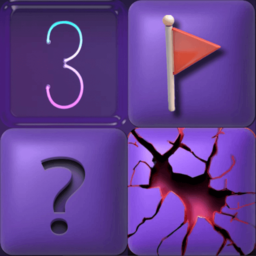
Use a flag or marker on a covered cell when you believe it contains a mine. Flags are notes for the player; in most versions, you do not need to flag every mine to win. You normally win as soon as every safe cell is open. Opening a mined cell ends the round.
Some implementations guarantee that the first click is safe, while others use different board-generation rules. Chording also varies by version. If supported, clicking an already revealed number after placing the correct number of adjacent flags opens its remaining covered neighbors. It saves time, but a misplaced flag can make it open a mine.
How do you play Minesweeper step by step?
Play by converting each number into either confirmed mines or confirmed safe cells.
- Choose an easy board to reduce complexity. A smaller grid with fewer mines gives you clearer local deductions and more chances to recognize recurring patterns.
- Open an initial cell to reveal information. If the game permits a safe first click, starting near the center can expose more neighboring cells than a corner, though any opening may work.
- Find numbers with few covered neighbors. A 1 touching only one covered cell identifies that cell as a mine. Marking it gives nearby clues new information.
- Flag cells that must contain mines. Place a flag only when the surrounding numbers prove the mine's location, not merely because a cell looks suspicious.
- Open cells that must be safe. If a number already touches the required number of flagged mines, all its other covered neighbors are safe.
- Repeat the deduction across connected clues. Each safe opening reveals more numbers, and each confirmed mine can unlock several adjacent clues at once.
- Scan the entire frontier before guessing. The frontier is the boundary between revealed cells and covered territory. A forced move may exist far from the area you were studying.
- Use chording carefully when available. Confirm every adjacent flag before opening several cells at once. Chording speeds up solved positions but does not correct bad assumptions.
- Finish by opening all remaining safe cells. If only mines remain covered, the board is complete even if the game places the final flags automatically.
How do you read the numbers in Minesweeper?
Read every number as a constraint applying to all covered and flagged cells immediately around it.
Suppose a revealed 2 touches five cells: two flagged cells and three unflagged covered cells. If the flags are correct, the three unflagged cells are safe because the clue already has its two mines. Conversely, if a revealed 2 touches exactly two covered cells and no flags, both covered cells must be mines.
A useful mental calculation is:
Mines still needed = clue number - adjacent confirmed mines
Compare that result with the number of adjacent covered, unflagged cells. If zero mines are still needed, open those cells. If the number of mines still needed equals the number of covered cells, flag them all.
Do not read clues in isolation. Two overlapping clues often reveal information that neither clue provides alone. If one group of covered cells must contain one mine and a larger overlapping group must also contain one mine, the extra cells in the larger group are safe.
How do you win at Minesweeper consistently?
You win more consistently by prioritizing certain deductions, checking overlapping clues, and postponing uncertain moves.
Start with the most constrained clues. Numbers beside only one or two covered cells are easier to solve than numbers facing a large unopened region. After every flag or safe opening, rescan nearby numbers because their remaining requirements have changed.
Separate facts from assumptions. A flag should mean confirmed mine, not probable mine. If you use flags for guesses, nearby deductions can inherit the mistake and produce a chain of apparently logical but false conclusions. Some players use question marks for uncertain cells when the game supports them.
Work from both sides of a pattern. A row of clues may look ambiguous from the left but become forced when examined from the right. Corners and board edges are useful because edge cells have fewer neighbors, reducing the number of possible mine arrangements.
Keep the global mine count in mind near the end. If five covered cells remain and the counter indicates three unmarked mines, exactly two of those cells are safe. The counter is only reliable if your existing flags are correct, so treat it as a consistency check rather than proof of any individual cell.
For speed, use both mouse buttons efficiently if the version supports them: one action to open and another to flag. Accuracy matters more than pace while learning. Fast players are quick because they recognize deductions immediately, not because they click before checking.
Which Minesweeper patterns should you learn?
The most useful patterns are simple clue relationships that identify safe cells or mines without trial and error.
A common edge pattern is 1-1. If the first 1 can only be satisfied by one of two covered cells, and the second 1 touches those same cells plus an additional cell, that additional cell is safe. This is an example of subset reasoning: the smaller clue group already contains every mine required by the larger group.
The 1-2-1 pattern can identify mines when three clues sit along a straight boundary with three corresponding covered cells. In the clean form of the pattern, the outer two covered cells are mines and the middle cell is safe. However, the result depends on the exact neighborhood. Extra covered cells above, below, or diagonally can change the solution, so verify the geometry instead of matching the visible numbers alone.
Likewise, a 1-2-2-1 boundary can force the two middle covered cells to be mines in its standard isolated form. Memorized patterns are shortcuts for deduction, not replacements for counting neighbors.
What mistakes do new Minesweeper players make?
Beginners most often lose by guessing too early, overlooking diagonal neighbors, or treating an uncertain flag as a confirmed mine.
The first mistake is opening a cell because it feels likely to be safe. Before doing that, scan every revealed boundary. A different clue may provide a guaranteed move, and solving it can expose information about the uncertain area.
The second mistake is forgetting that diagonal cells count. A corner 1 can refer to a mine diagonally inward, not just a cell beside it horizontally or vertically. Trace all eight positions around a clue whenever the board becomes confusing.
Another error is counting flags instead of mines. A clue describes actual mines, regardless of where you placed markers. If a deduction creates a contradiction, such as a 1 touching two flags, do not assume the board is broken. Recheck your flags and undo the one that was based on weaker evidence.
Players also chord too aggressively. Chording around a 3 with three flags feels safe, but the action trusts all three flags at once. Verify them before clicking. Finally, avoid staring at one cluster for too long. Moving your attention around the frontier often reveals an obvious forced move elsewhere.
Do you ever have to guess in Minesweeper?
Some boards require a probability-based choice, although certain versions generate boards designed to be solvable without guessing.
If no logical move exists, compare the risk of available cells instead of choosing randomly. A covered cell constrained by a clue may have an estimable mine probability. Cells in a completely unopened region share risk based on the number of mines not yet accounted for. The best move is usually the cell with the lowest chance of containing a mine, especially if opening it could reveal a large area.
Be cautious with apparent 50-50 choices. Check whether the global number of remaining mines eliminates one arrangement, or whether a distant clue connects to the pattern. If the position truly has two equally valid solutions, no local tactic can guarantee success. Making the lower-risk choice is part of playing that board correctly, even if the result is unlucky.
What Minesweeper variants can you play?
Minesweeper variants preserve clue-based deduction while changing the board, presentation, progression, or competitive goal.
Three-dimensional versions make spatial awareness part of the puzzle. Before applying familiar patterns, confirm which cells count as neighbors because adjacency may differ from the classic eight-cell square grid.
RPG-themed interpretations combine the core idea with a broader progression or adventure presentation. Use the in-game instructions to identify which classic rules remain unchanged and which actions have additional effects.
Competitive versions can reward speed, accuracy, territory, or another scoring system. The underlying counting skills still help, but the best move may depend on the match rules rather than safety alone.
What are the best Minesweeper games to play free?
The best version is one with readable clues, responsive controls, clear flagging, and a difficulty level suited to how you want to play.
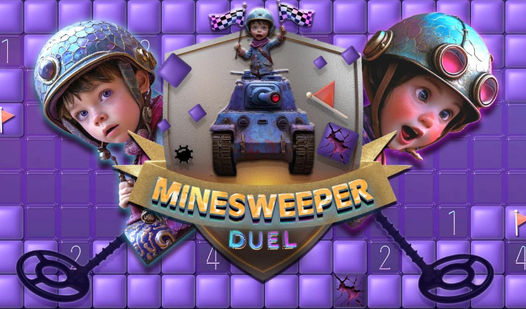
Choose a classic board when learning rules and patterns. Try a 3D or RPG variation once ordinary grids feel familiar. For direct competition, Minesweeper Duel offers a format built around playing against an opponent; check its instructions for the precise scoring and victory conditions.
Whichever version you choose, begin slowly. Confirm what each number requires, mark only proven mines, and open only proven safe cells. That small discipline turns Minesweeper from a guessing game into a repeatable logic puzzle.
FAQ
What does a number mean in Minesweeper?
A number shows exactly how many mines are in the cells directly surrounding it, including diagonals. A 3 therefore has three mines among its adjacent covered or flagged cells.
Do you have to flag every mine to win Minesweeper?
Usually not. Most versions award the win when every non-mine cell has been opened. Flags are tools for recording deductions, although individual variants may use different completion rules.
Is Minesweeper always solvable without guessing?
No. Traditional random boards can produce positions with multiple equally valid mine arrangements. Some modern versions generate no-guess boards, but you should check the rules of the game you are playing.
What is the fastest way to improve at Minesweeper?
Practice counting adjacent cells accurately, apply the two basic deductions, and review why each loss happened. Learning overlap and edge patterns will improve both speed and consistency.