
How to Play Nonograms: Rules, Steps, and Strategy

Nonograms are logic puzzles in which number clues tell you which squares to fill in each row and column. Every number represents a consecutive block of filled squares, and separate blocks must have at least one empty square between them. Start with clues that nearly fill their lines, mark every certain square, and use the completed information to solve the crossing lines.
What are the rules of nonograms?
The goal is to fill exactly the squares described by the clues without guessing.
A clue such as 5 means that the line contains one uninterrupted block of five filled squares. A clue of 3 1 means that a block of three appears first, followed later by a single filled square. There must be at least one empty square between those two blocks, but there may be more. The blocks must appear in the listed order.
Rows and columns describe the same grid from different directions. A square is correct only if it works with both its row clue and its column clue. This crossing relationship is what lets you deduce the solution.
Use a filled mark for squares that belong to a block. Mark squares that cannot be filled with an X, dot, or other empty symbol provided by the game. Empty marks matter: they separate blocks, close completed runs, and prevent you from reconsidering impossible positions.
A clue of 0, a blank clue, or another empty-line symbol means that the whole line should remain unfilled. The exact display varies between games, but the logic is the same.
How do you play nonograms step by step?
Solve a nonogram by alternating between rows and columns and recording only information that must be true.
- Read the grid and clues to establish the puzzle size. Count the cells in a line before calculating where its blocks can fit.
- Clear zero-clue lines to create immediate crossing information. Mark every square in an empty row or column with an X.
- Fill complete lines to secure easy blocks. If a ten-cell row has the clue 10, fill all ten squares. If its clues plus required gaps occupy all ten cells, place every block and separator exactly.
- Overlap long blocks to reveal guaranteed squares. In a ten-cell line with a clue of 7, imagine placing the block as far left and as far right as possible. The four cells covered in both positions must be filled.
- Check the crossing lines to turn new fills into deductions. Every confirmed square narrows the possible placements in its column or row.
- Extend identified blocks to satisfy their clues. If a clue requires a run of four and you know which run contains two adjacent filled cells, test how far that run can legally extend.
- Close completed blocks to protect their boundaries. Once a run has reached its required length, mark the squares immediately before and after it as empty when those squares exist.
- Repeat the strongest available deduction until the grid is complete. Recheck clues after every useful change instead of scanning the board in a fixed order.
On touchscreens, a game may use separate fill and X modes or cycle through states with repeated taps. On desktop, the mouse buttons or a toolbar often separate filled and empty marks. Check the control hints before working quickly, since an accidental fill can create a misleading contradiction.
How do you win at nonograms without guessing?
You win consistently by comparing every block's earliest and latest legal positions, then filling only their shared certainties.
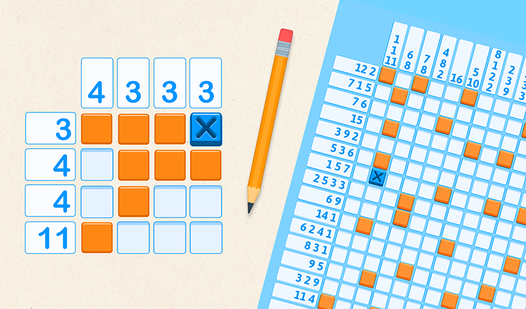
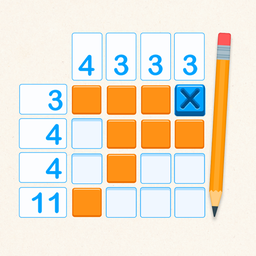
Overlap is the basic technique. For a single run of length k in a line of length L, a centered overlap exists whenever k is greater than half of L. The guaranteed portion has 2k - L cells. You do not need to memorize the formula; placing the run mentally from both ends produces the same answer.
For lines with several clues, include the mandatory one-cell gaps. A ten-cell line with clues 4 3 needs at least eight cells: four filled, one empty, and three filled. Only two cells of slack remain, so the possible positions are tightly constrained. Compare the earliest legal arrangement with the latest one and fill any cells occupied by the same block in both.
Use these deductions together:
- Edge logic: If a filled square near an edge belongs to a long block, the block may have only a few possible starting positions.
- Block completion: A finished run creates empty boundary squares and can eliminate one clue from further consideration.
- Impossible space: If an open gap is too short for any remaining clue, mark the entire gap empty.
- Clue assignment: Decide which clue a known group can belong to. Earlier and later blocks cannot cross or change order.
- Line totals: Compare the remaining unfilled capacity with the lengths of unresolved blocks and their separators.
If progress stops, inspect lines with the least free space, the longest unresolved block, or several confirmed cells. These usually contain more information than almost empty lines with short clues. A well-constructed standard nonogram should yield to deduction, although difficult puzzles may require carefully testing alternatives. If you do test a possibility, keep it separate from confirmed marks and reject it as soon as it creates a contradiction.
What mistakes should beginners avoid?
The most common mistake is treating a possible placement as a confirmed one.
A clue of 4 does not mean that the first four available squares should be filled. The run could occupy any legal group of four until crossing clues restrict it. Likewise, two filled squares separated by unknown cells do not necessarily belong to different blocks.
Avoid these habits:
- Forgetting the required empty square between consecutive blocks of the same color.
- Marking only filled squares and leaving known empty cells unrecorded.
- Extending a run beyond its clue length after it is already complete.
- Solving a row while ignoring contradictions created in its columns.
- Assuming clues can be rearranged instead of following their listed order.
- Guessing because one line looks ambiguous when another line may provide the missing fact.
When the board becomes inconsistent, find the earliest uncertain move rather than erasing random sections. Check for a run that is too long, too many completed runs, or too little remaining space for a clue. Those simple tests locate many errors quickly.
What types of nonograms can you play?
Most nonograms use the same crossing-clue logic, but grid size, colors, presentation, and separator rules can change the experience.
Black-and-white nonograms are the clearest place to learn. Filled cells form a monochrome picture, and every pair of consecutive clue blocks needs at least one empty square between them. Small grids make deductions easier to see, while large grids demand more careful tracking.
Color nonograms assign colors to clues and cells. Runs of the same color normally require a gap, but differently colored runs may be allowed to touch. Always read the game's rules because this detail changes how a line can be arranged.
Some versions emphasize pixel-art pictures, while themed games wrap the grids in a setting or collection. Timed modes, limited mistakes, hints, and automatic line completion alter the pressure, but not the central task. For learning, choose a mode that lets you correct marks freely and use hints only after identifying where your reasoning stopped.
What are the best free nonogram games to play?
The best practice game has readable clues, distinct fill and empty marks, responsive controls, and puzzles that progress from manageable grids to denser challenges.
Start with a plainly presented title such as Nonogram or Classic Nonogram when you want to concentrate on the standard rules. A neutral presentation makes it easier to practice overlap, completed-block boundaries, and row-column scanning without expecting unusual mechanics.
Choose a themed option when a stronger visual identity helps you stay engaged. Rats House Nonogram offers a catalog entry with a specific theme, while the underlying genre still revolves around interpreting row and column clues.
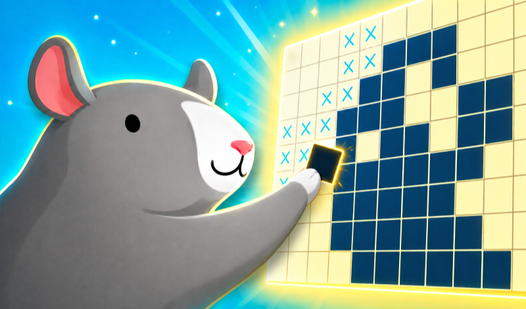
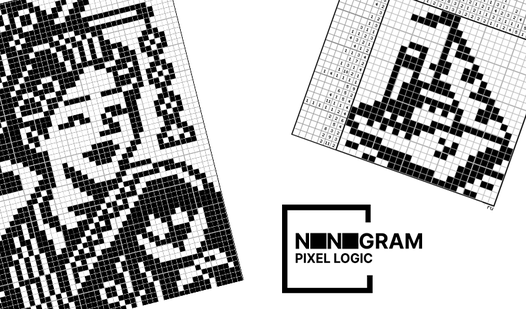
A pixel-focused title is a natural fit if revealing the hidden picture is your favorite part of solving. Nonogram Pixel Logic signals that familiar connection between formal deduction and pixel-art results. Begin with smaller available puzzles, if the game offers a choice, and move upward only when you can finish without relying heavily on hints.

Whatever title you choose, judge difficulty by more than grid dimensions. A large grid with long clues can be easier than a small grid filled with short, flexible runs. Good progression introduces tighter clue combinations gradually and gives you enough visual feedback to distinguish confirmed fills, known empties, and untouched squares.
FAQ
What do the numbers in a nonogram mean?
Each number gives the length of one consecutive block of filled squares. Multiple numbers appear in order and normally require at least one empty square between their blocks.
Can nonograms be solved without guessing?
Most standard nonograms are intended to be solved logically. Use overlap, completed-block boundaries, impossible gaps, and crossing clues before testing an assumption.
What should I do when I get stuck on a nonogram?
Recheck lines with little unused space, long remaining clues, or confirmed filled cells. Then compare each block's earliest and latest possible positions.
Are nonograms the same as Picross?
Picross is a widely used name for the same basic puzzle format. Nonograms are also called picture crosswords, griddlers, and Japanese crosswords.