
Sudoku Tips and Tricks: Solve Puzzles Without Guessing

Sudoku is a logic puzzle: fill every empty cell so each row, column, and outlined 3x3 box contains 1 through 9 exactly once. Start by scanning units with many given digits, place only numbers forced by the rules, and add candidate notes when no single is obvious. You win by completing the grid without contradictions or guesses. The most useful Sudoku tips and tricks eliminate candidates until one value or one location remains.
What are the rules of Sudoku?
The rule is simple: every row, column, and 3x3 box must contain each digit from 1 to 9 once.
A standard puzzle has 81 cells arranged in a 9x9 grid. Some digits are supplied as givens and cannot be changed. You fill the remaining cells while respecting all three constraints. A digit may appear several times across the whole grid, but never twice in the same row, column, or box.
Sudoku does not require arithmetic. The digits could be replaced by nine different symbols without changing the puzzle. Treat them as labels and ask where each label can legally go.
A row, column, or box is often called a unit. The cells that share a unit with a chosen cell are its peers. Thinking in units and peers makes advanced techniques easier to understand: every placement removes that digit from the candidates of all its peers.
Most published standard puzzles are intended to have one solution. You should not need to guess between two equally plausible cells. If a move creates a duplicate or leaves a cell with no possible value, an earlier placement or candidate elimination was wrong.

How do you play Sudoku step by step?
A reliable solving routine moves from definite placements to candidate-based deductions, then repeats as the grid changes.
- Scan the givens to find productive areas. Start with rows, columns, and boxes containing many digits because they have fewer missing values.
- List the missing digits in one unit. Compare those digits with intersecting rows, columns, and boxes to determine where each can fit.
- Place naked singles immediately. If a cell has only one legal candidate, enter it; that placement may create new singles nearby.
- Find hidden singles within each unit. A cell can have several candidates yet still be forced if it is the only cell in its row, column, or box that can accept a particular digit.
- Add small candidate notes when scanning stalls. Record every legal value, not just the one that feels likely. Accurate notes expose pairs and other patterns.
- Eliminate candidates with patterns. Use locked candidates, pairs, triples, and advanced formations only when their full conditions are present.
- Rescan after every useful deduction. Candidate elimination often produces a single elsewhere, so return to simpler methods before searching for another complex pattern.
This loop is more efficient than studying the whole board randomly. Work one unit at a time, make a deduction, and use its consequences before moving on.
What Sudoku tips and tricks help beginners most?
The best beginner techniques are systematic scanning, cross-hatching, naked singles, hidden singles, and careful candidate notes.
Start with the missing-number method. If a row contains 1, 2, 4, 5, 7, and 9, its missing digits are 3, 6, and 8. Check the empty cells against their columns and boxes. If two cells reject 6, the remaining cell must contain 6.
Cross-hatching applies the same idea to a box. Suppose you are placing 5 in the upper-left box. Existing 5s in nearby rows and columns rule out cells along those lines. If only one cell in the box remains available, place 5 there. Scan one digit across all nine boxes to make this process easier to see.
Do not confuse naked and hidden singles. A naked single has only one candidate written in its cell. A hidden single may share its cell with other candidates, but one of them occurs nowhere else in the unit. Check both cell by cell and digit by digit.
Pencil marks are useful only when maintained. After placing 7, remove 7 from every candidate list in the same row, column, and box. Leaving stale notes can hide singles or create a pattern that is not real.
Another useful habit is to count candidate locations rather than filled digits. If a box needs a 4 and exactly two cells can contain it, those cells may not yet be solvable, but their positions can restrict 4 elsewhere.
How do you win at Sudoku without guessing?
You win consistently by making only deductions whose logic you can explain and by checking each move against all three units.
Before entering a digit, finish the sentence: this cell must be 8 because it is the only legal value here, or because it is the only place for 8 in this unit. If your reason is merely that one option looks better, continue searching.
When stuck, do not immediately test a candidate. Refresh the notes, inspect boxes that intersect nearly complete rows, and search each digit from 1 through 9. Many apparent dead ends come from overlooking a hidden single or failing to remove an obsolete candidate.
If the game flags an error, undo the unsupported entry and restore any candidates removed because of it. Correcting only the visible conflict may leave the underlying damage in several peer cells.
Speed comes after accuracy. Experienced solvers appear fast because they follow a repeatable scan order and recognize familiar patterns, not because they take more risks.
Which intermediate and advanced Sudoku tricks should you learn?
After singles, learn locked candidates and pairs first; techniques such as X-Wing are useful for harder grids but occur less often.
A pointing pair or triple appears when every candidate for a digit inside one box lies in the same row or column. That digit must occur somewhere along that line inside the box, so it can be removed from the rest of the line outside the box.
A claiming pattern works in the opposite direction. If every candidate for 6 in a row lies inside one box, 6 can be removed from the other cells of that box.
A naked pair is formed when two cells in one unit contain the same two candidates and no others. Those two digits must occupy the two cells in some order, allowing both digits to be removed from other cells in the unit. Naked triples follow the same principle across three cells and three total candidates.
A hidden pair occurs when two digits appear as candidates in exactly the same two cells of a unit. Other candidates can be removed from those cells because the two reserved digits must fill them.
An X-Wing uses two rows and two columns. If a digit can appear in exactly the same two columns in each of two rows, the four candidate positions form a rectangle. The digit must occupy opposite corners, so it can be eliminated from other cells in those two columns. The pattern also works with rows and columns reversed.
Apply these methods precisely. A nearly matching pattern does not justify an elimination.
What common Sudoku mistakes should you avoid?
The most damaging mistakes are guessing early, scanning only one type of unit, and treating incomplete notes as complete evidence.
A candidate is possible, not probable. Never place it simply because it appears in fewer cells than another digit. Likewise, a pair is valid only if its candidates and unit relationships satisfy the exact definition.
Check the row, column, and box before every placement. Beginners often notice that a digit is absent from a row but miss the same digit already present in the cell's box.
Avoid filling every candidate at the start of an easy puzzle. Dense notes add visual noise and create maintenance work. Use direct scanning first, then add candidates where needed. On a hard puzzle, fuller notes are helpful, but they must be updated after each placement and elimination.
Do not fixate on one crowded area. If a section produces no deduction after a careful pass, move to another unit or scan a different digit. Progress elsewhere can unlock it later.
What Sudoku variants can you play?
Sudoku variants retain the idea of constrained placement but may change the grid, regions, symbols, or additional rules.
Small 4x4 and 6x6 puzzles teach scanning with fewer candidates. Diagonal Sudoku also requires the main diagonals to contain every digit once. Irregular Sudoku replaces square boxes with differently shaped regions. Killer Sudoku adds outlined cages whose digits must reach stated sums, combining placement logic with arithmetic.
Always read a variant's instructions before applying standard assumptions. Extra constraints create new eliminations, but the familiar row, column, and region checks usually remain the foundation.
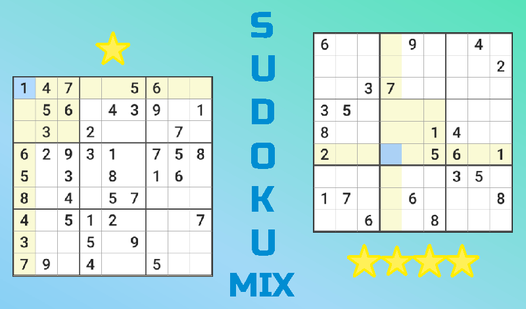
What are the best free Sudoku games to play online?
The best browser Sudoku games make the grid readable, support accurate candidate notes, and let you practice without distracting you from the logic.
Look for clear highlighting of the selected cell, its row, column, box, and matching digits. Candidate controls should be easy to toggle without causing accidental full-size entries. Undo is valuable for studying an error, while optional conflict warnings help beginners learn the rules. A timer can be motivating, but it should not pressure you into guessing.
Difficulty labels vary between games. An easy puzzle should usually yield to scanning and singles. Medium puzzles may require locked candidates or pairs, while hard puzzles can demand longer candidate chains and advanced patterns. If one game's level feels inconsistent, try another implementation rather than assuming your skill has suddenly changed.
Use the catalog cards as practice boards, not as promises that every title has identical options. Begin with a classic grid, concentrate on explaining each placement, and compare interfaces to find one that keeps candidates legible. Another catalog version can also give you a fresh puzzle when you have become visually stuck on the current board.
FAQ
What is the easiest trick for solving Sudoku?
Scan a nearly complete row, column, or box, list its missing digits, and eliminate positions using the two intersecting units. This frequently reveals a naked or hidden single.
Is guessing allowed in Sudoku?
You can guess, but a properly constructed standard puzzle should be solvable by logic. Guessing makes mistakes harder to trace and does not teach reusable solving patterns.
What should I do when no Sudoku moves are obvious?
Update every candidate affected by recent placements, search for hidden singles digit by digit, then inspect locked candidates and pairs. Move to a different unit if one area remains unproductive.
How can I get faster at Sudoku?
Use the same scan order on every puzzle, keep candidate notes accurate, and practice recognizing one technique at a time. Reliable pattern recognition improves speed more than rushing entries.