
How to Play Sudoku: Rules, Steps, and Strategies

Sudoku is a logic puzzle in which you fill a grid so every row, column, and outlined box contains each required digit exactly once. In a standard 9×9 puzzle, that means placing the numbers 1 through 9 without repeating any number in a row, column, or 3×3 box. Start by finding empty cells where eight of the nine digits are already ruled out. You do not need arithmetic or guessing, only careful elimination.
What are the rules of Sudoku?
The basic rule is that each digit may appear only once in every row, column, and box.
A standard Sudoku board has 81 cells arranged in nine rows and nine columns. Thicker lines divide it into nine 3×3 boxes. Some cells contain given numbers, often called clues, while the remaining cells must be filled by the player.
Every completed row must contain 1 through 9. The same is true for each column and each 3×3 box. A number can therefore be legal in a cell only if it is absent from all three areas connected to that cell. The clues cannot be moved, and a properly constructed puzzle has one logical solution.
Numbers are symbols in Sudoku, not quantities. You never add, subtract, or compare them. A puzzle using nine letters or shapes could follow exactly the same rules.

How do you play Sudoku step by step?
You solve Sudoku by repeatedly checking what each empty cell and each missing digit can legally become.
- Scan the givens to find crowded areas. Begin with rows, columns, and boxes that already contain many digits because they offer fewer possibilities.
- Choose one missing digit. Check where that digit already appears in the intersecting rows, columns, and boxes to eliminate blocked cells.
- Place any forced digit. If only one cell can hold the chosen digit, enter it and immediately rescan the affected row, column, and box.
- List candidates for uncertain cells. Use small notes to record every digit that remains legal instead of relying on memory.
- Find cells with one candidate. A cell reduced to a single possibility is a naked single and can be filled safely.
- Find digits with one possible position. If a digit has only one legal cell within a row, column, or box, it is a hidden single even when that cell has several written candidates.
- Update candidates after every placement. Remove the placed digit from related cells so new singles and patterns become visible.
- Repeat before using a harder technique. Most progress comes from fresh scans after the board changes, not from staring at one difficult area.
- Validate the finished grid. Confirm that every row, column, and box contains all required digits once and has no duplicates.
How do you win at Sudoku?
You win by completing the entire grid correctly, with no repeated digit in any row, column, or box.
Sudoku is usually untimed, so a correct solution matters more than speed. Some browser versions track mistakes or completion time, but these are scoring features rather than core rules. If a game limits mistakes, verify a placement against all three areas before committing it.
A strong solve is based on deductions that can be explained. Guessing between two candidates may appear faster, but one wrong assumption can corrupt several later placements. If you seem stuck, check your notes, rescan completed digits, and look for a forced position elsewhere on the board.
What Sudoku strategies should beginners learn?
The most useful beginner strategies are crosshatching, singles, candidate pairs, and box-line interactions.
Crosshatching means tracing rows and columns through a 3×3 box. Suppose a box needs a 7. Existing 7s in nearby rows and columns may block every empty cell except one. This is often easier to see by focusing on a single digit across the whole board.
Naked singles are cells with only one legal candidate. Hidden singles are digits that have only one possible location within an area. Hidden singles are easy to miss because the winning cell may still display several candidates until you compare it with neighboring cells.
A naked pair occurs when two cells in the same row, column, or box contain the same two candidates and no others. Those digits must occupy the two cells in some order, so they can be removed from every other cell in that area. The same principle extends to triples, although beginners rarely need to search for them deliberately.
A box-line interaction appears when all candidates for a digit inside one box lie on the same row or column. Because the digit must occupy one of those cells, it cannot appear elsewhere on that line outside the box. The reverse pattern also works: if every candidate for a digit on part of a row lies inside one box, remove that digit from other cells in the box.
Use candidates selectively. Filling every cell with five or six possibilities can create visual noise. First scan for direct placements, then add notes in the areas where progress has stopped.
What are the most common Sudoku mistakes?
The most common errors are checking only two constraints, guessing too early, and failing to update candidate notes.
A digit may fit a row and column but still duplicate a number in its 3×3 box. Check the row, column, and box every time. Another common mistake is treating a candidate as a confirmed answer. A penciled 4 means that 4 is possible, not that it must go there.
Do not assume a puzzle is stuck just because one corner offers no move. Sudoku deductions interact across the grid, so solving a cell on the opposite side may unlock that corner. Rotate your attention among digits and areas.
Messy notes also cause errors. Remove candidates after each confirmed placement. If you reach a contradiction, such as an empty cell with no legal digit, review recent entries before continuing. The earliest unsupported placement is usually more important than the cell where the contradiction appeared.
What types of Sudoku can you play?
Sudoku variants preserve the idea of unique symbols while changing the board, regions, or extra constraints.
Mini Sudoku commonly uses 4×4 or 6×6 grids and is useful for learning elimination. Larger puzzles may use 12×12 or 16×16 boards. Diagonal Sudoku requires the main diagonals to contain unique digits too. Jigsaw Sudoku replaces square boxes with irregular regions. Killer Sudoku adds outlined cages with target sums, making arithmetic relevant even though the normal uniqueness rules still apply.
Other versions use colors, pictures, letters, or decorative themes. The symbols may change, but the central question remains the same: which option can legally occupy this cell?
What are the best Sudoku games to play free?
The best free Sudoku game has a readable grid, convenient candidate notes, clear mistake feedback, and difficulty options suited to your current skill.
For a first session, choose a board whose clues and box boundaries remain easy to distinguish at a glance. Helpful controls include a candidate mode, undo, number highlighting, and the ability to pause. Automatic error warnings are useful while learning, but turning them off later can train you to verify deductions yourself.
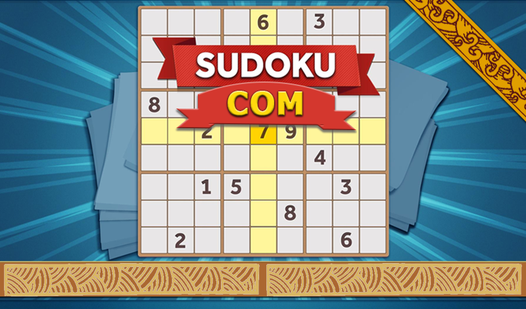
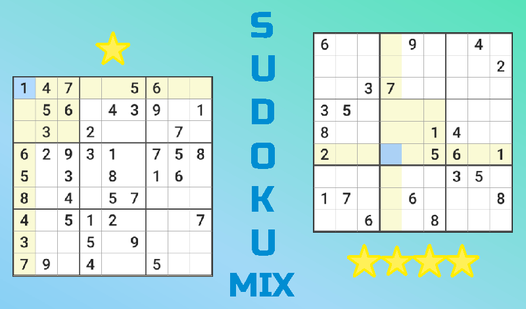
The catalog includes several ways to play. Sudoku.com offers another board interface to compare with the first game, while Sudoku Mix is an option to open when you want to explore a different presentation or available board choices. Since controls and modes can vary between games, try more than one and keep the interface that helps you read the grid without distraction.

Begin on an easy puzzle and concentrate on accurate reasoning rather than the timer. Move up when you can finish consistently without guesses. A harder label is not automatically better practice; the right puzzle is one that makes you use a new technique without forcing random choices.
FAQ
Do you have to be good at math to play Sudoku?
No. Standard Sudoku uses numbers as symbols, and solving it requires pattern recognition and logical elimination rather than calculation.
Can a number repeat diagonally in Sudoku?
Yes, in standard Sudoku. Diagonal repetition is allowed unless the repeated cells also share a row, column, or box. A diagonal variant may add different rules.
What should you do when you get stuck in Sudoku?
Rescan the most complete rows, columns, and boxes, then examine one digit across the whole grid. Update candidates and look for hidden singles, pairs, or box-line interactions.
Is guessing allowed in Sudoku?
A game may let you guess, but a well-formed standard puzzle can be solved logically. Guessing is risky because a wrong entry can produce a chain of convincing but invalid placements.