
How to Play Checkers: Rules, Moves, and Strategy

Checkers is played by moving pieces diagonally across the dark squares of an 8-by-8 board. Each player starts with 12 pieces. A regular piece moves one square forward, captures by jumping over an adjacent enemy, and becomes a king on the far edge. Captures are compulsory, and you win by taking every opposing piece or leaving your opponent with no legal move.
This guide focuses on American checkers, also called English draughts. Other versions change the board size, capture rules, or powers of kings, so check the selected game's instructions before starting.
What are the rules of checkers?
The basic rules are to move diagonally, make a jump whenever a capture is available, crown pieces that reach the opposite back row, and remove or immobilize the opposing army.
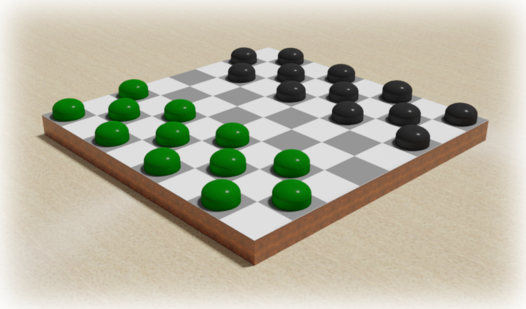
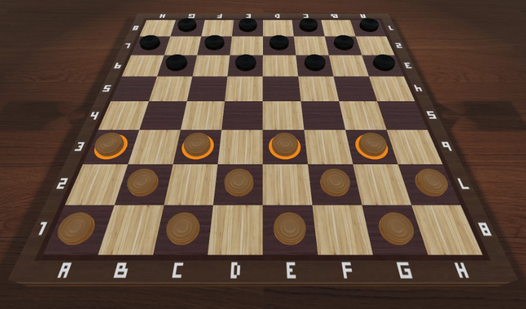
Set up the board with a dark square at each player's lower-left corner. Place 12 pieces per side on the dark squares of the nearest three rows, leaving the two middle rows empty. Black moves first under standard American rules, although a browser game may assign colors automatically.
A regular piece moves diagonally forward by one empty square. If an enemy piece occupies an adjacent forward diagonal square and the square immediately beyond it is empty, you jump to that empty square and remove the enemy. You must capture when possible. If the same piece can capture again after landing, continue jumping during the same turn.
When several captures are available, American checkers normally lets you choose the starting piece and route. You do not have to take the greatest possible number of pieces. That rule differs in some international variants.
A piece reaching the farthest row becomes a king. Kings move and capture one square or one jump at a time in both diagonal directions. In standard American play, reaching the king row during a capture ends that turn; the newly crowned king moves as a king on its next turn.
How do you play checkers step by step?
Follow the turn sequence carefully, because overlooking a compulsory jump is the most common rules error.
- Arrange the pieces to create the starting position. Put 12 pieces on each side's first three dark-square rows and leave the center open.
- Identify the first player to begin legally. Black usually starts in American checkers, while the game interface may choose for you online.
- Scan the whole board to find captures. If any of your pieces can jump an opponent, you must capture instead of making a normal move.
- Choose a legal jump to remove an enemy. Move over the adjacent opposing piece into the empty square beyond it, then take the jumped piece off the board.
- Continue with the same piece to complete a multiple jump. Check from its new square after every landing and keep capturing while another legal jump exists.
- Move diagonally forward when no capture exists. Advance one regular piece to an adjacent empty dark square, or move a king forward or backward.
- Reach the opposite back row to gain a king. Mark or stack the piece so both players can distinguish its new movement powers.
- Remove or block the opposing force to win. The game ends when your opponent has no pieces or no legal move.
How do checkers pieces move and capture?
Regular pieces move and capture diagonally forward, while kings can move and capture diagonally forward or backward.
Only dark squares are used, so every piece remains on the same color of square throughout the game. A normal move covers one square. A capture covers two squares: the occupied square being jumped and the empty landing square beyond it. You cannot jump your own piece, land on an occupied square, or capture two adjacent pieces in one leap.
A multiple jump is a sequence of separate captures by one piece. Direction may change between jumps if the piece is already a king. A regular piece in American checkers cannot jump backward. Recheck the board after every landing rather than assuming the turn is finished.
American kings are not flying kings. They move only to an adjacent square and jump only over an adjacent enemy. International draughts and several related variants allow kings to travel across multiple empty squares, which produces very different tactics.
How do you win at checkers?
You win by eliminating every enemy piece or creating a position in which the opponent cannot make a legal move.
Strong play begins with forced moves. Before choosing a move, inspect captures for both sides. Ask where your piece will land, what your opponent will be forced to jump, and whether you can recapture afterward. A piece that appears free may be bait for a two- or three-jump sequence.
Keep nearby pieces connected so they protect useful landing squares. Isolated pieces are easier to trap or sacrifice against. Control of the center usually gives more routes, but the edge can temporarily protect a piece because it reduces the directions from which it can be attacked. The trade-off is lower mobility.
Promotion matters, but racing one unsupported piece toward the king row is often predictable. Create two threats or clear a protected path instead. At the same time, do not empty your own back row carelessly. A well-timed rear defender can delay an enemy promotion, although keeping every back piece frozen for too long leaves the rest of your army short-handed.
When ahead in material, trades usually simplify the path to victory. Offer one-for-one exchanges that reduce the opponent's counterplay. When behind, preserve pieces, avoid routine trades, and seek a fork, trap, or forced multi-jump that can restore the balance.
What checkers strategies help beginners improve?
The most useful beginner strategy is to calculate forcing captures first, then compare the safety and mobility of your remaining legal moves.
Use these habits during every game:
- Count material after exchanges. A move is not profitable merely because it captures first; calculate the complete forced sequence.
- Protect landing squares. Place a supporting piece where it can recapture an enemy that jumps one of your pieces.
- Advance as a group. Two or three connected pieces are harder to attack than a lone piece pushed several rows ahead.
- Preserve options. A piece with two possible routes is more useful than one trapped behind its own formation.
- Use sacrifices with a purpose. Giving up one piece can be correct if it forces an enemy onto a square that starts a longer capture.
- Activate kings. Once crowned, bring a king toward important central diagonals instead of leaving it idle on the back edge.
In an endgame, mobility can matter more than the raw piece count. Two cramped pieces may lose to a well-positioned king. Try to restrict the opponent while keeping escape squares for yourself. If you have the lead, do not rush into a corner where your pieces obstruct one another.
What mistakes do new checkers players make?
Beginners most often lose by missing compulsory captures, evaluating only the first jump, or weakening their formation for a quick promotion attempt.
A legal-move scan should come before strategy. Look at every piece, including one near the edge or behind your main group. Browser games may highlight a required capture, but learning to see it yourself improves tactical awareness.
Do not stop calculating on the capture square. The landing square determines whether the jumping piece is safe, exposed, or positioned for another jump. Also inspect the opponent's forced reply. Many apparent blunders are deliberate sacrifices.
Avoid moving the same piece repeatedly without a concrete reason. While it races forward, the rest of your army remains undeveloped. Do not abandon the back row all at once, but do not treat it as permanently untouchable either. Good defense changes as the position changes.
Finally, never assume every game uses identical rules. Mandatory maximum captures, backward captures by regular pieces, flying kings, and promotion during a jump sequence all depend on the variant.
What are the main variants of checkers?
Checkers has several major variants, and the biggest differences involve board size, capture priority, and king movement.
American checkers uses an 8-by-8 board, 12 pieces per player, forward-only movement and captures for regular pieces, and short-range kings. International draughts uses a 10-by-10 board with 20 pieces per side. Its regular pieces can capture backward, kings have long-range movement, and the route taking the greatest number of pieces is compulsory.
Brazilian draughts uses an 8-by-8 board with several international-style rules. Russian draughts also permits backward captures by regular pieces and handles promotion during capture sequences differently from American play. Turkish draughts replaces diagonal movement with horizontal and vertical movement.
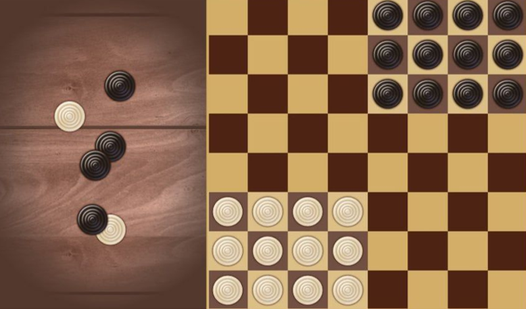
Some browser titles use the word checkers for related board games or special layouts. A catalog entry such as Corners Checkers may signal a rules variation rather than a standard American match, so read its controls and victory condition before applying familiar tactics.
What are the best checkers games to play free?
The best free checkers games explain compulsory moves clearly, distinguish kings from regular pieces, and let you restart quickly enough to test a different idea.
For learning, begin with a standard checkers title and confirm that it follows the rules described above. Play slowly enough to examine every forced capture. After you understand ordinary movement, try another catalog version to see how its interface or rules affect your decisions. A variant is useful practice only after you know which rule has changed.
The catalog includes several plainly titled checkers entries as well as variant-labeled choices. Because controls and rule settings can differ between individual browser games, use the title card as a way to start playing, then rely on the game's own instructions for its exact implementation.
How should you practice checkers?
Practice by reviewing one decision at a time instead of measuring progress only by wins and losses.
For your next few games, adopt a simple routine before every move: find all captures, predict the opponent's forced response, compare landing squares, and check promotion threats. After a loss, locate the first exchange that left you down a piece or trapped. Replay the position mentally and find a safer alternative.
Short sessions work well if each game has a focus. In one game, keep your pieces connected. In another, calculate every multi-jump to its end. Then practice converting a material advantage by exchanging pieces without sacrificing mobility.
FAQ
How many pieces are used in checkers?
Standard American checkers uses 24 pieces, with 12 pieces for each player.
Can regular checkers pieces move backward?
Not in American checkers. Only kings move or capture backward, although regular pieces may capture backward in some variants.
Do you have to jump in checkers?
Yes. A capture is compulsory in standard American checkers, and a multiple jump must continue while the same piece has another legal capture.
Can a checkers game end in a draw?
Yes. Repeated positions, prolonged play without progress, or mutual agreement can produce a draw, depending on the rules used by the game.