
How to Play Backgammon: Rules and Strategy

Backgammon is a two-player race game played with 15 checkers per player, two dice, and a board of 24 narrow points. Move your checkers around the board toward your home area, block or hit opposing checkers when possible, and bear off all 15 before your opponent. To start, set up the checkers in the standard formation, roll one die each, and let the higher roll make the first move using both numbers.
What are the rules of backgammon?
The basic rules require you to move according to the dice, avoid blocked points, re-enter any checker on the bar, and bring every checker home before bearing off.
The board contains 24 triangular points divided into four groups of six. Each player views the points in the opposite direction: point 24 is the farthest from home, while points 1 through 6 form that player's home board. The players move in opposite directions.
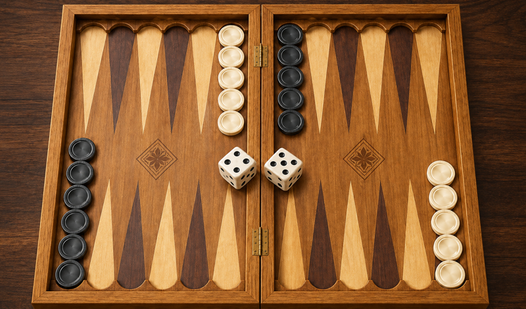
For the standard setup, each player places two checkers on the 24-point, five on the 13-point, three on the 8-point, and five on the 6-point. The positions are mirrored, so both players begin with the same distribution.
At the beginning, each player rolls one die. The higher number goes first and uses both opening numbers. Reroll a tie. On later turns, the active player rolls two dice and makes one move for each number. A roll of 3 and 5 can move one checker three points and another five, or one checker eight points if the intermediate landing point is legal. You may play the numbers in either order.
A checker may land on an empty point, a point occupied by your own checkers, or a point holding exactly one opposing checker. Two or more opposing checkers close a point completely. A single exposed checker is called a blot. Landing on it hits the checker and sends it to the bar.
A player with a checker on the bar must re-enter it in the opponent's home board before moving anything else. Each die corresponds to an entry point. If every possible entry is blocked, the player loses the turn. If only one checker can enter, the remaining die may be used only when another legal move is available after entry.
You must use both dice whenever legally possible. If only one die can be played, you must use it. If either number can be used but not both, the higher number must be played. Doubles count four times, so double 4s provide four separate four-point moves.

How do you play backgammon step by step?
Play each turn by reading the board first, moving every legal die, and protecting your checkers while advancing toward home.
- Set up the checkers - create the standard mirrored position. Place two checkers on your 24-point, five on the 13-point, three on the 8-point, and five on the 6-point.
- Roll for the opening - determine who moves first. Each player rolls one die; the higher roller moves using both numbers shown.
- Choose a legal landing point - keep every move within the rules. Land only on an open point, meaning one with no more than one opposing checker.
- Use both dice - complete as much of the roll as possible. Move two checkers or combine the numbers with one checker when the intermediate point is open.
- Hit a blot - delay the opponent when the risk is worthwhile. Land on a lone opposing checker to place it on the bar.
- Enter from the bar - restore trapped checkers before doing anything else. Use a die to enter through the corresponding point in the opponent's home board.
- Build useful points - make safe structures and restrict movement. Two or more of your checkers secure a point and prevent the opponent from landing there.
- Bring every checker home - qualify for bearing off. Move all 15 checkers into your six-point home board.
- Bear off checkers - remove them with exact or permitted higher rolls. An exact roll removes a checker from its point. A higher roll may remove the checker farthest from the edge only if no checker occupies a higher point.
- Remove all 15 first - win the game. The first player to bear off every checker wins, regardless of how many checkers remain on the board unless match scoring is being used.
How do you win at backgammon?
You win a game by bearing off all 15 checkers first, but winning consistently requires knowing when to race, block, attack, or preserve contact.
A normal win is worth one point. If the loser has not borne off any checkers, the result is a gammon and is usually worth two points. If the loser has not borne off a checker and still has one on the bar or in the winner's home board, the result is a backgammon, usually worth three points.
Matches are often played to a target score. Many versions also use a doubling cube. Before rolling, a player may offer to double the current value of the game. The opponent can accept and continue at the higher value or refuse and lose the game at its previous value. Beginners can learn movement and position play without the cube, then add doubling once ordinary decisions feel comfortable.
The most important strategic choice is whether the position is still a contact game. If opposing checkers can hit or block one another, safety and board control matter. Once the last opposing checkers pass each other, the game becomes a pure race. At that point, hitting plans are irrelevant and efficient movement becomes the priority.
What beginner strategy works best in backgammon?
The best beginner strategy is to make strong points, limit exposed blots, and change plans according to whether you are ahead or behind in the race.
Start by valuing your home-board points. Closing several consecutive points creates a prime, a wall that opposing checkers cannot cross. A six-point prime is completely impassable while it remains intact. Even a shorter prime can waste several opposing rolls, especially when a checker is trapped behind it.
An anchor is a secured point in the opponent's home board. It gives your rear checkers somewhere safe to stand and preserves opportunities to hit later. Do not abandon a useful anchor merely because moving forward feels productive. If you are behind, continued contact may be your best chance to recover.
Count pips when the position becomes race-like. A pip count measures the total distance your checkers still need to travel: multiply each occupied point by the number of checkers there, then add the results. A lower count means you are ahead in the race. You do not need to calculate after every roll, but learning to estimate the difference prevents major strategic errors.
If you are ahead, reduce contact and bring your checkers home safely. If you are behind, preserve anchors, blocks, and hitting chances. Racing from behind without a tactical reason usually helps the leading player.
Use spare checkers as builders. A point overloaded with five or six checkers is safe but inflexible. Moving a spare into range of several useful points can prepare a strong block next turn. The checker may temporarily become a blot, so compare the value of the plan with the opponent's direct hitting numbers.
Avoid judging a move only by how far it advances. A move that travels eleven total pips can still be poor if it breaks a key point or leaves two vulnerable blots. Board structure often matters more than raw distance while contact remains.
What common backgammon mistakes should you avoid?
The most common mistakes are overlooking compulsory moves, exposing unnecessary blots, breaking useful points too early, and treating every position as a race.
Beginners often combine the dice automatically without checking the intermediate point. A checker using 3 and 5 as a combined move must be able to land legally after the first number as well as after the second. Changing the order can make the move legal, so test both routes.
Another frequent error is forgetting that checkers on the bar take priority. You cannot move a different checker first to open an entry point. Entry must happen with the board exactly as it stands after the opponent's turn.
Do not hit every blot simply because you can. A hit can be strong when the opponent has difficulty entering or when it improves your board. It can be harmful if your hitting checker is likely to be hit back while your home board is weak. Compare the opponent's return shots and entry chances before attacking.
Bear-off play also rewards accuracy. Keep an even distribution when possible and avoid leaving large gaps. Checkers stacked on one low point may waste high numbers, while isolated checkers on high points can require extra rolls. During a close race, one inefficient bear-off decision can decide the game.
Which backgammon variants should you know?
The two most useful variants to recognize are short backgammon, which usually follows the familiar hitting rules, and long backgammon, which changes the starting formation and interaction between checkers.
Short backgammon is the standard contact game described above. Blots can be hit, the bar plays a central role, and defensive anchors compete with attacking home-board structures.
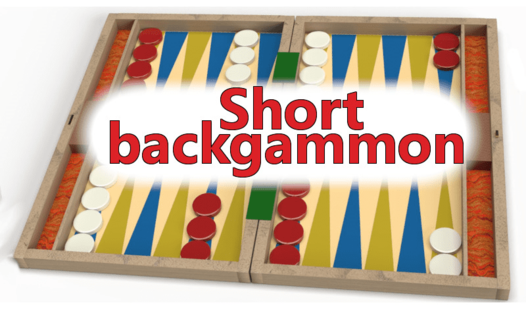

Long backgammon, often associated with Narde, usually starts all 15 checkers together and does not allow checkers to be hit. Blocking, timing, and movement order become especially important. Exact rules for blockades and opening moves may differ between implementations, so read the version's rule panel before assuming standard backgammon rules apply.
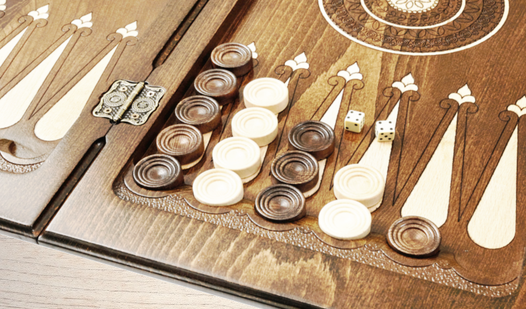
Other regional variants may change the starting position, use special opening rolls, or begin with fewer checkers. The board can look identical while the legal tactics differ considerably.
What are the best backgammon games to play free?
The best free backgammon game is one that explains legal moves clearly, uses the variant you want, and lets you restart quickly enough to practice specific decisions.
For learning standard movement, choose a plainly labeled backgammon or short-backgammon game. Look for visible destination markers and a clear bar area. These features make it easier to understand why a move is legal or blocked. A move history or undo option is useful for practice, although competitive modes may intentionally disable undo.
A 3D presentation can make the board feel more physical, while a flat board may be easier to scan. Neither presentation changes the strategy. Choose the view in which you can quickly identify closed points, blots, the bar, and the direction of play.
Use long backgammon only when you deliberately want that variant. Its no-hitting structure develops planning and timing, but it will not teach bar entry or the tactical risks of blots. Alternating between short and long games can be instructive once you understand which rules have changed.
For effective practice, play a few games with one goal at a time. In one session, focus on using both dice correctly. In another, count exposed blots before confirming each move. Later, estimate the race before choosing between contact and safety. Focused repetition improves decision-making faster than simply playing quickly.
FAQ
Can you move the same checker twice in backgammon?
Yes. You may use both dice on one checker if the intermediate landing point and final landing point are legal. With doubles, the same checker can potentially move up to four times.
Do you have to use both dice in backgammon?
Yes, if both numbers can be played legally. If only one can be used, you must use that number. When either number works but both cannot be played, you must use the higher one.
When can you start bearing off in backgammon?
You may begin only after all 15 of your checkers are in your home board. If one is hit during bearing off, you must re-enter it and bring it home again before removing more checkers.
Is backgammon mostly luck or skill?
Dice create short-term uncertainty, but move selection, risk management, pip counting, cube decisions, and match strategy strongly influence results over repeated games.