
Duck Rescue: Screw Clear Walkthrough and Level Guide

To clear a level in Duck Rescue: Screw Clear, remove parts according to their dependencies rather than simply tapping whatever is available. Start with screws that unlock other elements, preserve free storage space, and check where a panel will move after each action. The goal is not to unscrew everything as quickly as possible. You need to dismantle the structure in a safe order and free the ducks without creating a dead end.
What is the basic principle behind Duck Rescue?
The basic principle is to remove screws and connected parts in an order that clears the structure above the ducks or opens their escape route.
Every move can affect several objects. A panel may fall, rotate, reveal another screw, or cover a useful area. An exposed screw is therefore not always the correct target. First identify the piece that directly prevents the rescue, then examine the fasteners supporting it and the layers above it.
It helps to read the puzzle backward. Find the last object that must disappear before the ducks are safe. Next, identify the screws preventing that object from moving. Continue tracing the dependency chain until you reach an action that is currently available. This backward approach is much more reliable than tapping screws at random.
If your version has a limited temporary tray for removed screws or parts, treat every open slot as valuable. Filling the tray can end an attempt even when legal moves are still visible on the board.
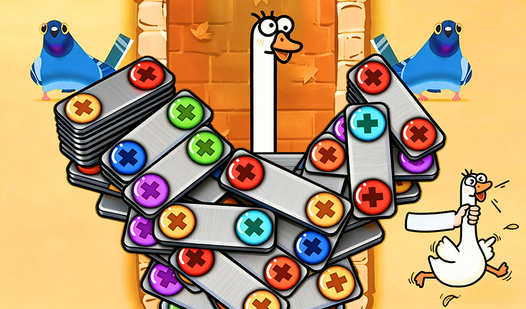
How do you play step by step?
Study the board briefly at the start, then dismantle the structure from its upper dependencies toward the object trapping the ducks.
- Locate the ducks and their exit - identify which panels actually block the rescue and which pieces are distractions.
- Choose the final blocking object - establish a clear objective instead of trying to empty the entire board.
- Trace its fasteners backward - reveal the chain of screws and parts that must be handled first.
- Predict the first result - confirm that removing a screw will expose something useful or let a panel leave safely.
- Remove the upper dependency - unlock the next screw without creating another obstacle lower on the board.
- Watch your free slots - preserve enough space for mandatory pieces that appear later.
- Reassess after a panel falls - account for its new position instead of following an outdated plan.
- Clear the main obstruction - open the escape route only after its supporting pieces are under control.
- Restart an early dead end - recover quickly instead of spending more moves on a position that cannot be repaired.
Do not tap immediately after an animation just because another screw becomes visible. Wait until every part has stopped moving. A newly exposed object can look useful during the fall but end up belonging to a different dependency chain.
I usually divide a stage into smaller jobs: open the central area, clear a side layer, prepare storage space, and then remove the final obstruction. This makes it much easier to identify the exact move that broke the sequence.
How can you clear difficult levels without random moves?
Difficult stages become manageable when you map dependencies, protect your free space, and compare the consequences of two possible moves before choosing one.
Look first for screws that support several accessible parts or reveal a closed section. They are usually more useful than fasteners attached to an isolated object. Before removing one, however, predict the direction of the fall. A large panel may cover a screw you need for the next step.
Before any uncertain move, I ask two questions: what will become available, and what could become blocked? If I cannot give a concrete answer to the first question, I leave that screw alone. This rule filters out most moves made only because an object is highlighted or easy to reach.
I also avoid using the final free storage slot for an optional screw. Even a harmless-looking move can cause a panel to reveal a fastener that must be removed immediately. Keeping one position in reserve gives you room to correct the sequence.
When choosing between a small part and a large panel, judge them by the opportunities they create rather than their size. A small piece that reveals two screws is more valuable than a large panel that merely disappears. Progress is measured by new continuations, not by the number of objects removed.
Use hints, undo options, or other available tools after you have analyzed the board. Identify two plausible sequences first, then use assistance to test the uncertain point. Otherwise, a hint may show a legal move without teaching you why it works, leaving you stuck again a few actions later.
How do you beat level 1360 in Duck Rescue?
Approach level 1360 by tracing the dependency chain backward from the final barrier, because the exact layout may differ between versions of the game.
Do not copy another player's opening move until you have compared their screws and panels with your own screen. Updates, browser builds, or repeating level sets can change the numbering and geometry. Reconstructing the solution from your current board is more dependable.
First locate the panel whose removal would free the ducks. Do not immediately tap its fasteners. Check which surrounding parts prevent that panel from moving or leaving the structure. Then decide which obstruction can be removed without filling the temporary tray or dropping a large object onto an important screw.
For a densely packed level, use this inspection order:
- Mark the final barrier and every screw holding it in place.
- Find a required screw that is currently covered by another part.
- Identify what supports the covering part.
- Choose an available fastener that begins opening this chain.
- Recheck the final barrier after every major fall.
- Keep at least one recovery option available if the board's mechanics allow it.
If an important screw becomes covered during the opening moves and your storage is already full, the mistake probably happened earlier. Restart and change the first action that caused the unwanted fall. You may not need an entirely new solution. Often, removing a neighboring support first is enough to make the original sequence work.
My practical method for long levels is to remember three checkpoints instead of every individual screw. I note which area opened first, which large part left second, and how much free space remained before the final barrier. This is much easier to reproduce after a restart.
How many levels are in Duck Rescue: Screw Clear?
There is no reliable permanent total without checking a specific version, since the developer can add stages or change their numbering.
The existence of level 1360 means that at least one build reaches that number, but it does not prove that 1360 is the final stage. An update may add more puzzles, introduce repeating cycles, provide daily challenges, or place new sets under the existing numbering system.
Check the level selection screen, update information, and what happens after the latest available stage. If another number appears after a victory, the main progression continues. If the game returns to the menu, starts repeating stages, or announces that more content is coming, you have reached the current limit of your version.
Do not treat an old search result as a fixed answer. The browser edition hosted on one site may contain a different number of stages from another release. The safest answer is that the game has many levels, while the current maximum depends on the active build.
Which mistakes stop you from rescuing the ducks?
The most common causes of failure are removing an exposed screw too early, running out of temporary space, and ignoring where a falling part will land.
The first mistake is clearing the edge of the board simply because it contains several open fasteners. This feels like progress but may do nothing for the ducks. Every removed screw should clear the main obstruction, reveal a fastener in the required chain, or create space for a mandatory action.
The second mistake is filling temporary storage with secondary pieces. Before a move, consider both the number of free positions and the mandatory screws that will appear after a panel falls. If the move reveals more objects than you can process, look for a different order.
The third mistake is continuing with an old plan after the board changes. The structure's physics can rotate or shift parts in an unexpected way. Pause after any major movement and verify that your target remains accessible. A few seconds of analysis cost less than a complete restart.
The fourth mistake is recognizing a dead end too late. If no move advances the required chain, the tray is nearly full, and an important screw is covered, random taps rarely save the attempt. Remember which fall created the problem and restart with a different opening order.
Finally, do not assume that every visible object must be removed. Some layouts may include parts that do not affect the rescue. Focus on the ducks' escape path and finish the required chain. Unnecessary clearing adds risk without always providing a benefit.
FAQ
These short answers can help you check your plan before another attempt.
How do I know which screw to remove first?
Choose a screw that opens the dependency chain leading to the final barrier and will not cause a falling part to cover an important fastener.
Why do I reach a dead end while screws are still visible?
The remaining screws may be inaccessible because of panel positions or a lack of temporary space. The actual mistake usually happened earlier in the removal order.
Can difficult levels be completed without hints?
Yes. Trace dependencies backward from the final obstruction, preserve recovery space, and revise your plan after every major movement.
Is level 1360 the final level?
Not necessarily. Level numbering and the total number of stages depend on the game version, so check the current limit inside your own build.