Best Crossword Puzzles Online: Rules, Tips and Games

The best crossword puzzles online combine fair clues, a readable grid, responsive controls, and difficulty that suits your session. In a crossword, you answer Across and Down clues by placing one letter in each open square; crossing answers must share the same letter. Start with clues you can solve immediately, then use those confirmed letters to unlock harder entries.
There is no single puzzle that will be best for every player. A five-minute grid is handy during a break, while a larger themed crossword rewards slower, more deliberate solving. The right choice gives you enough resistance to feel satisfying without forcing you to guess obscure answers with no help from crossings.
What are the rules of crossword puzzles?
The basic rule is simple: every answer must fit its numbered entry, match its clue, and agree with all intersecting answers.
Most grids contain open squares for letters and blocked squares that separate words. A numbered square begins an Across answer, a Down answer, or both. Enter one letter per open square. Where two answers cross, they use the same square, so the letter must work for both clues.
Clue wording matters. A plural clue normally asks for a plural answer, and a past-tense clue usually leads to a past-tense word. Abbreviated answers should have an indicator such as briefly or for short. A question mark can signal a pun or another playful interpretation. Proper names, foreign words, and informal expressions may appear, but fair puzzles give you enough crossings to work them out.
Some games reveal errors immediately, while others wait until you request a check. That is an interface choice rather than a change to the underlying rules. The goal remains the same: fill every open square correctly.
How do you play crossword puzzles step by step?
Solve a crossword by building outward from certain answers and letting each confirmed letter reduce the possibilities elsewhere.
- Scan every clue to find easy entries. Read the full Across and Down lists before wrestling with one difficult clue.
- Enter answers you know with confidence. Certain letters create dependable starting points for intersecting words.
- Check the answer length. Count the squares and reject any idea that cannot fit the available space.
- Match the clue's grammar. Keep tense, number, part of speech, and abbreviations consistent with the proposed answer.
- Use crossing letters to narrow choices. A pattern such as S_A_E can be easier to recognize than a clue in isolation.
- Switch sections when progress stops. Solving elsewhere may provide the crossing letter that the stubborn area lacks.
- Review conflicts before using a hint. One weak answer can make several correct clues appear impossible.
- Check the completed grid. Correct uncertain squares first, then confirm that every clue has a sensible answer.
Do not treat this as a strict order that you follow only once. Good solving is a loop: scan, fill, cross-check, revise, and move to a more productive part of the grid.
How do you solve crossword clues faster?
You solve faster by separating clues you can answer now from clues that need crossings, rather than giving every clue equal time.
Take the easy points first. Short common words, familiar abbreviations, obvious plurals, and clues tied to your strongest subjects can open a surprising amount of the grid. Enter them, then revisit neighboring clues with the new letter patterns visible.
Read for precision. If the clue is Runs quickly, an adjective like RAPID is unlikely because the grammar does not match. If the clue says once, formerly, or in poetry, it may be pointing to an older form. A question mark tells you to consider wordplay instead of relying only on the first dictionary definition.
Think in patterns, but do not force them. With C_A_E, several words may fit. The clue and every crossing must decide which one belongs. Players lose time when they fall in love with a plausible answer and twist the rest of the grid around it.
Use checks sparingly if the game provides them. Checking one doubtful letter after honest work can teach you something. Repeatedly revealing answers completes the board but does little to improve clue recognition. A useful compromise is to finish a section, inspect only the conflicts, and try repairing them before requesting another hint.
What mistakes do new crossword players make?
The most common beginner mistake is treating an early guess as a fact even after its crossing answers stop making sense.
- Staying on one clue too long: Leave it temporarily. Another answer may supply two or three letters and turn the clue into an easy solve.
- Ignoring grammar: A synonym can be conceptually correct but still fail because its tense, number, or part of speech is wrong.
- Writing a full guess from one crossing: One letter rarely proves an answer. Look for support from the clue and another intersection.
- Assuming every clue is literal: Puns, abbreviations, names, and phrases are normal parts of many crossword styles.
- Checking too soon: Immediate correction removes the productive struggle that teaches recurring vocabulary and clue patterns.
- Refusing to erase: Revision is part of solving. Replace the least certain answer at the center of a cluster of conflicts first.
Marking confidence mentally also helps. Separate facts, strong guesses, and placeholders. When a section breaks, review the placeholders before touching answers that are supported by several clean crossings.
What makes a good online crossword puzzle?
A good online crossword has fair clueing, reliable crossings, legible presentation, and controls that stay out of the solver's way.
The clues should be challenging for a reason. Difficulty can come from wordplay, broad knowledge, or an elegant theme, but answers should be defensible once revealed. An obscure proper name crossed only by another obscure proper name feels arbitrary. A rare answer surrounded by ordinary, solvable entries is much fairer.
The interface matters too. Clear highlighting should show the active entry and selected square. Keyboard input, simple direction switching, and visible clue numbers reduce friction. Optional checking is better than constant correction because players can choose how much help they want. On a phone, the grid and clue must remain readable without endless zooming.
For a straightforward word-focused session, Words Crosswords gives you another place to apply the standard scan-and-cross method. Start with the entries you recognize and use their intersections as evidence for the rest.
The best choice also matches your available time. Pick a compact grid for a quick break and a denser puzzle when you want to settle in. Difficulty labels are useful, but the clearest test is personal: you should make steady progress while still needing to reconsider a few clues.
What crossword variants can you play online?
Online crosswords include traditional word grids, themed puzzles, word-collection hybrids, cryptic crosswords, and number-based variants.
A standard American-style crossword uses Across and Down clues in a blocked grid. Themed puzzles connect several longer answers through a shared idea or word trick. Mini crosswords compress the same logic into a short session. Cryptic crosswords use clues with both a definition and constructed wordplay, so they require a separate set of conventions.
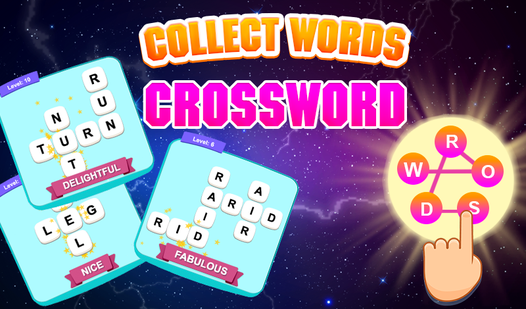
Some browser games blend crossword placement with collecting or forming words from a pool of letters. These can be approachable if direct trivia-style clues are not your favorite, though the exact rules may differ from a traditional newspaper grid. Collect Words Crossword is a relevant option for exploring that broader word-building side of the genre.
Mathematical crosswords replace ordinary vocabulary with numbers, equations, or arithmetic relationships. The crossing logic is familiar, but calculation supplies the entries. They are a useful change of pace for players who enjoy deduction more than general-knowledge clues.
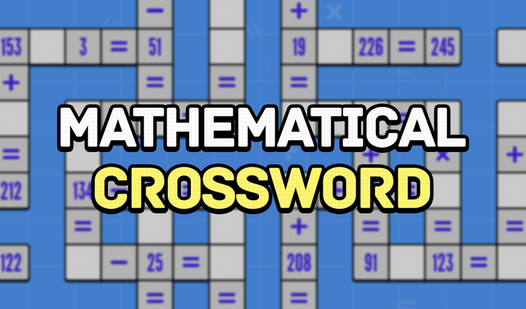
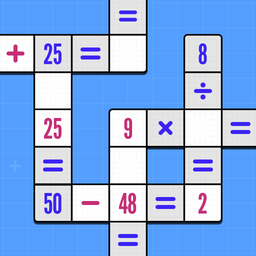
Try more than one format before deciding that crosswords are not for you. A player who dislikes trivia-heavy clues may enjoy word formation, while someone who finds ordinary vocabulary predictable may prefer mathematical constraints or cryptic wordplay.
FAQ
Can I play crossword puzzles online for free?
Yes. Browser crossword games can be played without buying a printed puzzle book, although available hints, ads, saving, and difficulty options vary by game.
Are online crosswords good for beginners?
Yes. Beginners can start with smaller grids, use crossings before guessing, and choose games with optional checks or hints. The best learning puzzle is challenging but still gives regular footholds.
What should I do when I am stuck on a crossword clue?
Move to another section, solve intersecting answers, verify the clue's grammar, and reconsider your least certain nearby entry. Use a hint only after those checks fail.
Do crossword puzzles always use words?
No. Most use words and phrases, but mathematical and other number-based crosswords use calculations or numerical relationships while keeping the same crossing structure.