
Mahjong Solitaire vs Classic Mahjong: Key Differences

Mahjong solitaire is a single-player matching puzzle, while classic Mahjong is a competitive game in which four players draw and discard tiles to build a winning hand. In solitaire, start by finding two matching tiles that are uncovered and open on at least one long side. Remove accessible pairs until the layout is empty. Despite the shared tiles and name, the two games have different rules, goals, and strategies.
What is the difference between Mahjong solitaire and classic Mahjong?
The simplest difference is that Mahjong solitaire is about clearing a layered board, while classic Mahjong is about assembling a legal hand before the other players.
Mahjong solitaire, also called Shanghai or a Mahjong matching game, normally has one player. Tiles begin in a stacked layout, and you remove them in pairs. A tile can be selected only if nothing covers it and at least one of its long sides is open. The puzzle ends when you clear every tile or run out of legal pairs.
Classic Mahjong is generally played by four people seated around a table. Players draw and discard tiles while forming combinations such as sequences and sets of identical tiles. Decisions involve hand efficiency, opponents' discards, scoring rules, and risk. There is no layered tableau, and matching two exposed tiles does not remove them from play.
The games use related visual symbols, including numbered suits, winds, dragons, flowers, and seasons. That shared artwork explains the name, but skill in one format does not automatically transfer to the other. Solitaire rewards spatial planning. Classic Mahjong combines probability, flexible hand building, memory, and defensive judgment.
What are the rules of Mahjong solitaire?
The core rule is that you may remove a matching pair only when both tiles are free.
A free tile has no tile resting on top of it and has space on either its left or right long side. It does not need both sides open. A tile trapped between neighbors is blocked even if its face is fully visible. Tiles beneath another layer remain blocked until every tile covering them has been removed.
Most numbered suit tiles, winds, and dragons must match exactly. A bamboo five pairs with another bamboo five, not a five from a different suit. Many versions treat flowers as one matching group and seasons as another, so two different flowers or two different seasons may form a legal pair. Browser implementations can vary, so check the game's help panel if a seemingly valid bonus-tile pair is rejected.
A standard puzzle uses many of the tiles found in a Mahjong set, often with four copies of ordinary symbols. The exact layout, tile count, hint system, and availability of shuffles depend on the version. Some deals are generated to be solvable, while others may reach a dead end. A shuffle can rescue a blocked board in casual versions, but using one is not the same as solving the original arrangement.
How do you play Mahjong solitaire step by step?
You play by repeatedly identifying legal pairs while choosing removals that expose the most useful tiles.
- Inspect the highest layers to find free tiles. Locate pieces with nothing above them and at least one open long side.
- Scan the entire board before matching. Discover all available copies of a symbol so you do not commit to the first visible pair automatically.
- Remove a legal pair to open the layout. Prefer a move that uncovers a hidden tile or releases a long blocked row.
- Compare alternative pairings of four identical tiles. Choose the combination that frees more positions and leaves the remaining two copies accessible.
- Work on tall stacks and long horizontal arms. Reducing these bottlenecks creates more selectable tiles and prevents isolated pockets.
- Recheck the board after every removal. A single pair can expose several new choices or make a formerly blocked edge tile free.
- Use hints for detection, not automatic strategy. A hint usually shows a legal move, but it may not identify the safest move.
- Clear every tile to win. If no legal pairs remain, undo recent moves, restart, or shuffle when the selected game permits it.
How do you win Mahjong solitaire more often?
The best general strategy is to maximize future choices instead of removing whichever pair is easiest to see.
Start with moves that change the board. A pair is especially valuable when it uncovers two tiles, releases tiles on both sides of a row, or lowers a tall stack. Removing two isolated edge tiles may be legal but accomplish little. If another pairing of the same symbol opens the center, that is usually the stronger move.
Pay close attention when three or four identical tiles are available. Suppose two copies are easy to reach, one blocks a major row, and one sits beneath a stack. Pairing the two easy copies could leave the important copies unable to meet. Pair an easy tile with the strategically valuable one when possible. The goal is not merely to make a pair now, but to preserve a path for every remaining copy.
Balance the board instead of clearing one harmless corner too aggressively. Tall central piles and long arms often restrict the largest number of tiles. Work on those areas while keeping several symbols available around the edges. More open tiles mean more possible pairs and less dependence on one exact sequence.
Memory helps even though every exposed tile remains visible. Track symbols you have seen beneath recently removed pieces and notice which matches are still buried. If undo is available, use it to test a branch after a dead end rather than restarting immediately. Rewind to the first decision where two different pairings were possible, not just the final legal move.
Classic Mahjong requires a different winning approach. There, players improve a hand by keeping useful connected tiles, discarding isolated pieces, and adapting to incoming draws. They also watch opponents' discards for clues and avoid dangerous late-game throws. Those ideas do not govern a solitaire layout because there are no opponents, concealed hands, or shared discard pool.
What beginner mistakes make Mahjong solitaire harder?
Most failed boards come from pairing too quickly, ignoring blocked copies, or treating every legal move as equally useful.
A common mistake is selecting the first highlighted match. Legal does not mean strategically sound. Pause when more than two copies of a tile are exposed and compare which pairing opens the board.
Another mistake is clearing easy edge pairs while leaving the tallest stack intact. Edge removals feel productive, but they may expose nothing. A move that lowers the top layer usually creates more options.
Players also overlook the exact free-tile rule. A visible tile is not necessarily playable: it may have a tile above it or neighbors touching both long sides. Conversely, a tile with one side blocked is legal if the other side is open and its top is clear.
Finally, hints can create false confidence. Many hint systems identify any current pair without calculating whether the resulting position can be completed. Treat a hint as help spotting tiles, then judge the move yourself.
What variants of Mahjong solitaire can you play?
Mahjong solitaire variants mainly change the layout, presentation, time pressure, and recovery tools while retaining free-tile matching.
Traditional-looking versions use familiar tile faces and layered shapes such as a turtle-style formation. Alternative layouts may be flatter, taller, symmetrical, or divided into separate clusters. Tall arrangements demand careful attention to vertical blockers, while wide layouts make side access and row release more important.
Three-dimensional versions let you inspect a structure from different angles. The presentation changes how you search for matches, but the central question remains similar: which pair can be removed, and what will that removal expose? Rotate or inspect the structure carefully before assuming that a tile is blocked.
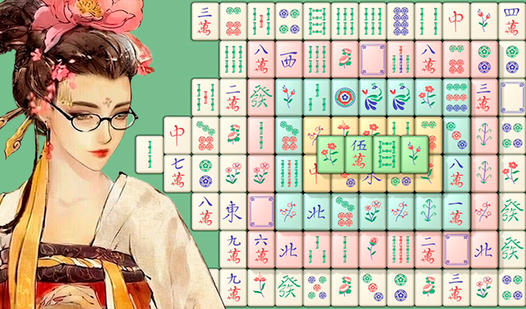

Other variants add timers, score multipliers, limited hints, reshuffles, undo, daily layouts, or nontraditional tile art. Emoji and picture tiles can make symbols easier to distinguish for some players, though unfamiliar artwork may initially slow scanning. Relaxed untimed modes are better for learning strategy because they leave room to compare alternative pairs.
What are the best free Mahjong solitaire games to try?
A good browser Mahjong solitaire game should make free tiles readable, respond clearly to selections, and provide layouts suited to your preferred difficulty.
Start with a conventionally presented version if you are learning the rules. Familiar symbols and a clear layered layout make it easier to understand why a tile is free or blocked. Once legal moves feel natural, try different arrangements to practice planning rather than memorizing one opening sequence.
A 3D version is useful if you enjoy rotating structures and searching from several viewpoints. An emoji-themed game changes the visual language without changing the essential matching logic, making it a reasonable choice when traditional suit symbols feel too similar. Titles labeled master or classic may also be useful catalog starting points, but difficulty and optional tools can vary between implementations.
Whichever version you choose, judge it by clarity rather than decorative complexity. You should be able to distinguish tile faces, see which pieces overlap, and understand why a selection succeeds or fails. Helpful options include undo for studying mistakes, hints for locating overlooked matches, and restart controls for testing a better route. Shuffles are convenient for casual play, but solving without them gives a better measure of planning.
FAQ
Is Mahjong solitaire the same as Mahjong?
No. Mahjong solitaire is a one-player tile-matching puzzle. Classic Mahjong is usually a four-player draw-and-discard game built around completing a legal hand.
Can Mahjong solitaire always be solved?
Not every implementation guarantees that every deal can be completed. Some games generate solvable layouts, while random deals or poor early pairings can produce a dead end.
Can I remove a Mahjong solitaire tile if only one side is open?
Yes. A tile is normally free when nothing covers it and either its left or right long side is open. Both sides do not need to be clear.
Do flowers and seasons have to match exactly?
Usually, any flower can pair with another flower and any season can pair with another season. Rules differ between games, so consult the selected version's instructions if the pair is not accepted.