
Hexelki Guide: How to Play and Score More Points

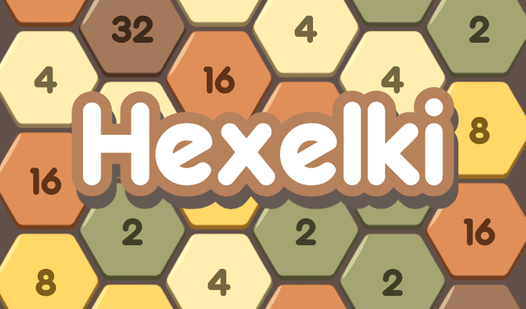
In Hexelki, you click groups of adjacent hexagons with matching numbers, merge them into a tile with twice the value, and keep the board from filling up. The aim is to build progressively larger numbers and score points. The core strategy is simple: do not grab the first available match. Preserve open cells, connect scattered groups, and prepare the next move before committing to the current one.
How do you play Hexelki?
Find two or more adjacent blocks with the same number and click their group to create a block of the next value.
Adjacency follows the sides of the hexagons, so most cells have more possible connections than they would on a square grid. Before clicking, trace the whole chain with your eyes. Matching blocks can extend diagonally, bend around another tile, or connect through a cell that is easy to overlook. If you merge a group too early, you may lose the chance to add one more matching block to it.
A merge creates a tile with twice the number. Matching values therefore move up one tier, and the resulting tile can later merge with another equal tile. Longer chains award more points, but a strong run is not built around one impressive merge. What matters more is whether that move leaves a follow-up. The game ends when the board fills and no useful merges remain. This is why usable space is more valuable than a large but isolated number. The same basic rules appear in the [game description](https://yandex.ru/games/app/453403).
How do you play Hexelki step by step?
Build every move so that the current merge clears space while preparing the next one.
- Scan the board - find every available group instead of stopping at the most obvious match.
- Mark the large tiles - identify which numbers are close to merging and which partners they still need.
- Check the edges - look for matching blocks near the perimeter, where they are harder to bring back into a shared cluster.
- Compare your options - choose the move that leaves more adjacent matches afterward.
- Merge smaller numbers - clear cells and create material for the next tier.
- Preserve connections - avoid splitting equal values with a wall of unrelated tiles.
- Continue the cascade - if the new block touches an equal one, use that match when it improves the board.
- Count open cells again - make sure an attractive move did not consume your safety margin.
- Rescan everything - treat the layout as a new position after every merge because the old plan may no longer work.
- Slow down - when several moves are available, mentally test at least two before clicking.
This routine only feels slower than random clicking at the beginning. After a few runs, you learn to notice danger zones first, chains second, and the click itself last. Your pace naturally improves, while far fewer games end because of one impulsive move.
How do you find the best merges?
The best merge is not always the longest one: choose the group that keeps large tiles connected and leaves open routes across the board.
Judge the shape of the position after the merge before thinking about the immediate points. A useful move usually does at least two of three things: removes excess low tiles, brings equal high values closer, and opens an area for future chains. If a move only scores now but traps an important tile among unrelated numbers, its value disappears quickly.
On a hexagonal board, search for clusters rather than straight lines. Start with one value and inspect its neighbors in a circle. Then ask whether merging smaller numbers could create another tile of the needed tier nearby. That is a practical two-move calculation: first build the matching value, then merge the pair or expand the group.
Compare alternative groups of the same tier as well. Two separate clusters may look equally good, but one clears the center while the other leaves a new block stranded at the edge. Choose the position with more life in it, not merely the prettier chain.
Why does the board fill up so quickly?
The board fills when you make isolated profitable merges without gathering scattered values into connected areas.
Fragmentation is the main cause of a loss. The board can contain many equal numbers, yet they do nothing if other ranks sit between them. Every split reduces the number of real moves. From time to time, ignore a distant large group and clean the area where small mismatched blocks have accumulated.
Edges are especially dangerous. A central cell has more potential neighbors, while an edge cell is constrained by the board geometry. If a rare large number remains on the perimeter, bringing a partner to it becomes harder. Do not turn the outside of the board into storage for unrelated values. Clear matches there while they are still reachable.
Open cell count is not the only measure of safety. Space helps, but connectivity matters more. Five open cells beside a useful group are better than the same number scattered through dead-end pockets. After each move, ask whether equal values have become easier to bring together. If the answer is no several times in a row, the board is already drifting toward a lock.
How should you plan moves on a hexagonal board?
Plan a direction of development rather than an exact long combo: decide where large numbers belong, where small ones should gather, and which area must be cleared first.
A rigid plan breaks quickly because every merge changes the layout. A working zone is more reliable. Keep the largest values in one connected part of the board and use smaller tiles as material nearby. This does not have to be a fixed corner or one particular cell. What matters is the ability to combine tiers without crossing a long stretch of clutter.
Think of the numbers as a ladder. To merge two large tiles, you first need tiles one tier below them. Those depend on even smaller matches. If a large number has no suitable material nearby, it has effectively stopped participating in the run. Before creating a new personal best tile, check whether it will be left alone.
Keep one flexible corridor between your working areas. This is a chain of cells through which future values can approach each other. Do not clog it with random tiles of different ranks. If the route starts getting messy, spend a couple of moves cleaning it even when a longer group is visible elsewhere.


Is a long chain better than a quick merge?
A long chain is better for points only when it does not damage the position; a quick merge is correct when it saves space or reconnects separated areas.
There is no rule that says you should always wait for the largest possible group. Waiting helps only while the board remains manageable. If you preserve a big group for one more tile and allow the surrounding cells to fill with unrelated numbers, the future bonus may cost the entire run. Sometimes the stronger move is to merge now, create the next value, and restore flexibility.
At the same time, do not break up a promising long chain without a reason. Before clicking, inspect all six directions around it. Check whether one preparatory merge could add another block of the same value. This brief calculation often earns extra points without creating meaningful risk.
Use a simple test. If you have plenty of space and the group can grow through one clear move, wait. If open cells are scarce, matching numbers are split, and preparation requires several uncertain actions, merge now. A stable run almost always outperforms a gamble built around one perfect chain.
How do you score more points in Hexelki?
To raise your score, maintain merge cascades, keep large tiles accessible, and judge every move by the continuation it creates.
Points rise with chain length and block value, but a high score comes from a sequence of decisions. Small numbers become medium ones, and those medium tiles feed the large ones. If you only wait for ready-made matches, the board gradually breaks into disconnected islands. A strong player actively assembles future pairs by clearing paths for the values they need.
Watch the balance between ranks. When the board holds too many different numbers with only one copy of each, there is little to merge. Reduce that variety by combining small groups into values that already exist nearby. However, avoid creating several isolated high tiles in different parts of the board. One accessible pair is more useful than three record tiles that can never meet.
Compare runs by more than the final score. Notice the state in which trouble began. Did an edge become blocked? Did the center split? Did you merge a promising group too soon? This review improves your play faster than instantly restarting. After a few attempts, you will spot a repeated mistake that can be removed deliberately.
What mistakes stop you from progressing?
The most common mistakes are rushing, chasing only large numbers, and judging a group without checking its surrounding cells.
The first mistake is clicking the moment you see a match. Hexelki gives no strategic reward for extra speed unless you are setting yourself a personal challenge. Pause briefly and check for another group of the same value. Merging that second group first may create a much stronger follow-up.
The second mistake is storing large numbers on the edges. They look satisfying but soon stop contributing. A high tile needs access to an area where its partner can be built. If unrelated values gather around it, start clearing a route early rather than waiting for a complete lock.
The third mistake is trying to rescue every messy area. Sometimes one zone is already badly fragmented. Do not spend every move making it look tidy if another part of the board offers a reliable cascade and more space. Priority goes to the move with the best continuation, not the most visually annoying patch of clutter.

What tips make your play more consistent?
Three specific habits help me most: scanning around a group in a circle, tracking isolated tiles, and briefly reviewing every loss.
My first tip is to move my eyes clockwise around a group before an important merge. On a hex grid, this makes it easier to catch a side branch in the chain. It is especially useful when many nearby tiles share similar colors and the numbers start blending together visually.
My second tip is to mentally flag every large tile that lacks both an equal neighbor and a clear route to a future partner. If several such singletons appear, I stop chasing a record value and return to clearing small numbers. That keeps the board alive longer.
My third tip is to choose the move that leaves more possible directions for the next merge when two options look similar. I do not need to predict the exact result. I only need to avoid pushing the new tile into a narrow pocket.
After a loss, I think about the decision made several moves before the final lock, not merely the last click. The final move often reveals a problem created earlier. That short review gives the next run a concrete goal: protect the edge, combine medium values sooner, or keep the center connected.
FAQ
What is the goal of Hexelki?
Merge adjacent tiles with matching numbers, create progressively higher values, score points, and prevent the board from filling completely.
Can you merge tiles diagonally?
Follow the shared sides of the hexagons. If equal blocks touch along a side and belong to one adjacent group, they can be merged.
Why do matching numbers sometimes fail to merge?
They are probably separated by another tile or only appear to touch without sharing a side. Check the full outline of each hexagon.
How can you survive longer?
Keep open areas connected, avoid trapping large numbers at the edge, and favor moves that leave at least one clear follow-up.