
Best Tower Defense Games: Free Picks and Strategy

The best tower defense games turn a simple rule into a demanding puzzle: stop enemies from reaching the exit by placing defenses along their route. Start by identifying the path, put reliable damage where it can cover enemies for the longest time, and save enough currency to react to the next wave. Strong play comes from balancing new towers, upgrades, and specialized effects instead of buying whatever is available.
What are the rules of tower defense games?
Your goal is to defeat each enemy wave before too many units cross the map or reach your base.
Most tower defense games give you a limited amount of currency, several building positions, and a visible or predictable enemy route. Defeated enemies provide more resources. You spend those resources on new towers, stronger upgrades, special abilities, or repairs. A level is won by surviving every scheduled wave; it is lost when your lives, health, or base durability reaches zero.
Towers usually fill different roles. Fast towers handle numerous weak targets, heavy weapons punish durable enemies, and slowing or stunning defenses keep targets inside firing range longer. Some weapons can attack flying enemies while others only hit the ground. Splash damage is strongest against groups, but it may be inefficient against a lone boss.
The crucial rule is coverage. A cheap tower firing through an entire bend can contribute more than an expensive tower that sees the path for only a moment. Before building, inspect where enemies enter, where paths overlap, and which positions cover corners or long lanes.
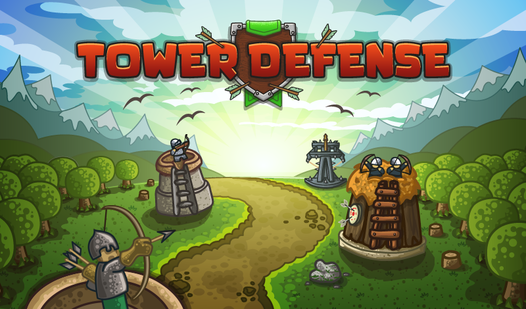

Use Tower Defense as a baseline for learning the genre's central rhythm: observe a wave, build with restraint, and adjust when the next threat exposes a weakness.
How do you play tower defense, step by step?
A successful run follows a repeatable cycle of scouting, building, watching, and correcting.
- Trace the route to find high-coverage positions. Look for bends, loops, intersections, and long straight sections before placing anything.
- Check the first wave to identify the immediate threat. Enemy count, speed, health, and movement type determine whether you need rapid fire, heavy damage, or crowd control.
- Build the smallest defense that can survive. Spending every coin immediately leaves no answer for a surprise unit or a second entrance.
- Combine complementary tower roles. Put slowing effects where several damage towers can exploit the extra firing time, and place splash damage where enemies naturally bunch together.
- Watch actual performance instead of trusting price. Notice where enemies escape range, which tower gets frequent shots, and whether damage is being wasted on nearly defeated targets.
- Upgrade proven positions for efficient power. A well-placed tower often deserves an upgrade before a new tower is added to a weak location.
- Prepare for the next wave before starting it. Read any available preview, cover missing enemy types, and keep a reserve if the game allows mid-wave construction.
- Change one part of the plan after a loss. Moving a tower, buying an earlier slow, or delaying an upgrade teaches more than rebuilding the entire layout at random.
Do not use the fastest wave-start option until your formation is stable. Extra speed saves time, but it also hides leaks, poor targeting, and moments when an ability should have been activated.
What are the best tower defense games to play free?
The best free tower defense games make decisions readable, give towers distinct jobs, and let better planning matter more than frantic clicking.
Good enemy waves also test different weaknesses. If every wave can be beaten by repeating one tower, placement and adaptation lose their purpose. A stronger design asks you to handle crowds, armored targets, fast runners, flying units, split paths, or bosses without making any single defense universally correct.
For a variation suggested by its path-focused premise, try Draw a Path Tower Defense 3D. Path-related formats can make route control part of the puzzle, so examine how your choices affect both travel distance and firing coverage.
Luma Tower Defense is another catalog option for comparing how a different presentation affects your ability to read targeting, range, and wave pressure. Give any unfamiliar game two or three attempts before judging its balance; the first run is often spent learning icons and upgrade rules.
For a darker change of atmosphere, sample Eerie Tower Defense. Theme does not replace good mechanics, but a distinctive setting can make repeated wave analysis feel less mechanical while you practice the same core skills.
When choosing among games, check whether tower ranges are visible, upgrades explain their effects, and enemy types can be distinguished quickly. Restart speed matters too. A useful tower defense game lets you test a revised plan without forcing you through a long sequence of menus or unskippable waiting.
How do you win at tower defense games?
You win consistently by maximizing useful firing time while spending resources on the weakness that could actually end the run.
Start with geometry. Towers near an inside corner may track a target through most of the turn, while towers between two neighboring lanes may attack both. Slowing effects belong before your strongest concentration of damage, not after it. Splash weapons need enough remaining path to finish survivors, so avoid making the exit your only area-damage zone.
Next, compare upgrades with expansion. One upgraded tower may gain damage, speed, range, or a new effect, but two basic towers can cover separate lanes and prevent leaks. Upgrade when a position is already firing frequently and the improvement solves a known problem. Expand when enemies spend too much time outside your existing range or when another route lacks coverage.
Keep some money flexible whenever the rules permit it. An untouched balance is not wasted if it allows you to counter a fast wave, reveal-resistant enemies, or reinforce a failing lane during combat. Once the current threat is understood, spend the reserve deliberately.
Targeting rules can be as important as raw damage. First-targeting helps stop leaks, strongest-targeting focuses tough enemies, and last-targeting may keep splash attacks centered on dense groups. If targeting can be changed, assign different priorities rather than letting every tower fire at the same leading unit.
Finally, treat lives as a resource but not as an excuse for a broken layout. Letting one weak enemy through can be cheaper than making a panic purchase. Letting the same type escape every wave signals a structural problem that should be fixed.
What beginner mistakes make tower defense harder?
The most common mistake is buying too many towers without checking whether they spend enough time firing.
A scattered field can look powerful while producing less damage than a compact group around a bend. Other frequent errors include upgrading a tower simply because the button is available, ignoring support effects, placing splash damage where enemies are already separated, and spending the entire budget before seeing what the next wave contains.
Beginners also tend to react only at the exit. Emergency defenses can save a wave, but repeatedly building near the goal shortens the time available to damage each enemy. Fix the earliest weak point instead. If enemies leave the opening section at full health, improve early coverage; if damaged enemies escape later, strengthen finishing damage or control.
Another mistake is judging a defense by one easy wave. Rapid-fire towers may dominate small enemies and then stall against armor. Heavy weapons can crush a boss but allow a crowd to pass between slow shots. Test the whole formation against contrasting threats.
After losing, pause before restarting. Identify the first enemy that crossed safely and ask why: insufficient damage, wrong damage type, poor range, missing control, or badly timed spending. That diagnosis gives the next attempt a clear purpose.
What tower defense variants should you try?
Different variants change who controls the route, how towers are placed, and how much direct action is required.
Fixed-path games emphasize choosing positions and upgrade timing. Open-field or maze-building variants let towers reshape enemy movement, turning path length into a resource. Some games use fixed tower slots, which removes pixel-perfect placement and makes the upgrade tree more important. Others add heroes, spells, or manually aimed attacks that reward timing alongside planning.
Puzzle-focused levels may limit your tower selection or budget and expect one efficient solution. Endless modes replace a final wave with escalating pressure, making long-term scaling and upgrade efficiency essential. Boss-heavy games favor concentrated damage and status resistance, while swarm-based levels reward area attacks and sustained control.
Try several formats before deciding which you prefer. The shared skill is not memorizing one perfect build. It is reading the map, predicting the next constraint, and converting limited resources into enough coverage to survive.
FAQ
Can I play tower defense games for free in a browser?
Yes. Browser tower defense games can be launched without buying a full game, making them useful for testing different maps, tower systems, and variants.
What tower should I build first?
Choose an affordable, reliable tower with good coverage of the opening route. The exact type matters less than placing it where it can fire repeatedly.
Should I upgrade towers or build more towers?
Upgrade towers in strong, frequently used positions. Build more when you need coverage on another path, a missing attack type, or extra control.
Why do I keep losing to later waves?
Your layout may be specialized for early enemies. Save resources, inspect wave previews, and add answers for armor, speed, crowds, flying units, or bosses before they arrive.