Mahjong Blast Guide: Boosters, Strategy, and Levels
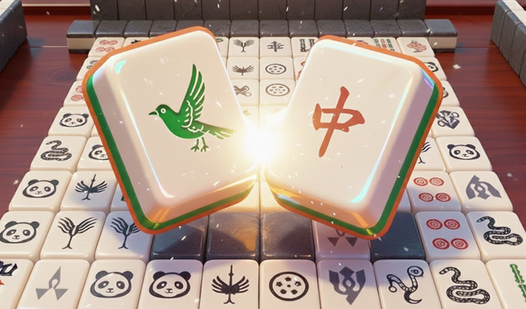
In Mahjong Blast, you match identical tiles and connect them with a clear line until the board is empty. The path cannot pass through other tiles and will usually allow no more than two turns. For consistent clears, open the edges and long corridors first, check which pairs each move will reveal, and save boosters for positions that normal matches can no longer repair.
How do you play Mahjong Blast?
To remove tiles, select two matching symbols that can be joined by an unobstructed path with the allowed number of turns.
A straight line is the simplest connection. A pair may also meet around one corner or through a route with two turns. If other tiles block the line or the route needs too many bends, the match will not count. You must remove the obstructing pairs and create more open space first.
The usual goal is to clear the entire board. If the level displays a timer, progress bar, or move limit, you must finish before that resource runs out. Do not click every pair of similar symbols you notice. A visual match is useful only when a valid route exists between the tiles.
Before making the first move, inspect the outer border, empty cells, and long rows. Edge pairs often create space for several later connections. Tiles inside a dense central block are better left alone unless removing them opens a useful passage.
How do you play step by step?
Reliable clears begin with a quick inspection of the board rather than pure clicking speed.
- Scan the layout and identify open pairs near the border, giving yourself early space without trapping the center.
- Check the route between matching tiles and confirm that it crosses only empty space with the permitted number of turns.
- Remove an edge pair and extend the outer corridor so more symbols can connect through it.
- Compare available moves and choose one that reveals another pair or two instead of leaving an isolated tile with no continuation.
- Open dense areas gradually and preserve several directions for future paths instead of relying on one narrow lane.
- Pause at a dead end and scan the edges, corners, and cleared cells again before spending a booster.
- Clear the remaining pairs in a safe order and watch the level restriction so a timer or final move does not cost you the win.
When many matches are available, plan a sequence of at least two moves. The first removes a pair, and the second uses the space it creates. This simple combination is more dependable than random clicking, especially in the middle of a level when the board still looks crowded.
How do you use boosters in Mahjong Blast?
Use a booster after checking the board yourself and only when its effect solves a specific problem instead of completing an obvious move.
The available tools may vary between versions. If your build includes a hint, shuffle, automatic pair removal, or extra time, check the description and icon for that particular tool. Some boosters activate immediately when clicked. Others ask you to select a tile or an area first.
A hint is useful when you have stopped noticing valid connections but do not want to rearrange the board. After following the suggestion, pause before clicking again. Inspect the newly opened route and see whether you can continue the sequence without more help.
A shuffle makes sense when the board has reached a genuine dead end or the remaining layout is exceptionally awkward. Using it at the start is wasteful because early pairs can normally be found without assistance. You will also have to rescan the entire board after the tiles move.
Save automatic pair removal for tiles that block a large section and cannot be connected normally. If an extra-time booster is available, activate it before the final seconds. This gives you enough room to assess the position calmly instead of spending the bonus on rushed clicks.
Before activating anything, check how many boosters remain and how the selected tool works. When supplies are limited, do not spend one on the first minor obstacle. Saving a difficult level is usually more valuable than gaining a few seconds on an easy layout.
What tactics do I use to clear levels?
I try to make every move prepare another connection instead of judging each pair in isolation.
- I begin with the outer border. Removing edge tiles creates a long open route. Symbols that appear separated inside the grid can often connect through this space.
- I do not remove an obvious pair automatically. I first check whether those tiles are blocking other symbols. A nearby move may reveal several matches at once, while the obvious pair will still be available later.
- I keep two possible paths in mind. If the first plan becomes blocked, I still have another direction to explore. This is especially useful in the center, where one misplaced tile can obstruct several routes.
- I separate scanning from clicking. I spend a few seconds reviewing the board by symbol type and then make a sequence of verified moves. This reduces mistaken clicks on similar but nonmatching designs and prevents wasted time.
On a timed level, this method only feels slow during the initial scan. In practice, a short pause costs much less time than repeatedly testing every pair on the board.
How do you clear levels without getting stuck?
To avoid dead ends, open several routes at once and do not leave single tiles trapped inside dense groups.
After every removal, ask two questions: what has opened, and what has become harder to connect? A strong move removes the current pair while improving the geometry of the board. A new empty row, accessible corner, or route to the border makes the position more flexible.
Pay particular attention to tiles surrounded on several sides. If a matching symbol still exists and a route can be created, plan that connection in advance. You do not always have to remove the pair immediately, but you should avoid closing its only possible corridor with other decisions.
If the current layout allows paths outside the border, check that route separately. Tiles on opposite edges may connect around the board even when there is no open internal path. If the game rejects the match, the route does not meet its restrictions and you will need to open an internal corridor.
When choosing between two moves, prefer the one that removes an internal barrier or enlarges an empty area. A simple edge pair will usually remain accessible, while the chance to dismantle the center may disappear.
What mistakes make Mahjong Blast harder?
Most failed levels come from rushing, spending boosters too early, or making moves without considering what happens next.
The first mistake is choosing any visible pair. If the move reveals nothing, the board becomes smaller but not necessarily easier. Compare at least two options before clicking.
The second mistake is confusing similar designs. Check small details, colors, and the orientation of each symbol. Failed attempts consume time and interrupt your scanning rhythm.
The third mistake is ignoring the center completely. Clearing the edges is convenient, but you must begin opening a dense central block before only awkward pairs remain.
The fourth mistake involves relying too heavily on boosters. A hint does not automatically fix the board geometry, and a shuffle does not guarantee an easy finish. After using any tool, assess the board as though you were looking at a new layout.
How many levels does Mahjong Blast have?
The exact number of levels depends on the version and its latest update, so the level map or in-game counter is the most reliable source.
If the interface shows the current stage alongside a total, use that figure. If it only displays the current number, scroll ahead on the level map when that option is available. At the end of the published layouts, the game may display a completion screen, a notice about future stages, or a repeating mode.
Do not rely on a number taken from an old walkthrough without checking the current build. A browser version can receive additional layouts. The core strategy remains the same: open routes in advance, preserve boosters, and consider what each pair removal changes.
Which similar games can help you practice?
You can train your observation skills by alternating Mahjong Blast with puzzles that require collecting sets of three or clearing tiles in a different order.
Triple-tile games usually do not require a route between symbols. Instead, you must manage the capacity of a lower tray and avoid collecting too many unrelated tiles. This develops forward planning, although it does not replace the connection rules used in Mahjong Blast.
Layouts with a different visual theme are also useful for learning how to distinguish similar icons quickly. Do not rely on color alone. Compare the shape, internal lines, and small decorative details.
When you return to Mahjong Blast, apply the same skill deliberately. Find every copy of one symbol first, then inspect the geometry between them. This makes your search faster without turning it into random trial and error.
FAQ
How do you connect two tiles in Mahjong Blast?
Select identical symbols with a clear route between them. The line cannot cross other tiles and will usually allow no more than two turns.
Why are two identical tiles not disappearing?
There may be no valid path between them, one tile may have been selected incorrectly, or the symbols may differ in a small detail. Clear nearby cells and try again.
When should you use a shuffle booster?
Use it after thoroughly checking the edges, corners, and open corridors, when no normal move remains or the layout has become exceptionally difficult.
Can you clear a level without boosters?
Many layouts can be solved with normal connections when you plan several moves ahead. Save boosters for dead ends, severe time pressure, or an awkward final group.