
How to Play Minesweeper: Rules, Number Clues, and Winning Strategies

How do you play Minesweeper?
Minesweeper is a logic game in which you uncover every safe square without opening a mine. Click a covered square to reveal it. A number tells you how many mines touch that square horizontally, vertically, or diagonally. Use those clues to identify safe squares and mark suspected mines with flags. You win when all non-mine squares are open. You do not normally need to flag every mine, although flags make complex boards easier to read.
The essential rule is simple: never treat a number as a direction. A 2 does not mean that a mine is two spaces away. It means exactly two of the maximum eight neighboring squares contain mines. Each clue must be combined with nearby clues.
1. Learn the board, controls, and first move
A board begins as a field of covered squares. On a computer, the primary mouse button usually opens a square and the secondary button places or removes a flag. On a phone or tablet, tapping normally opens a square, while holding it places a flag. Check the individual game's control hints because some versions also provide a dedicated flag button.
Opening a mine ends the round. Opening an empty square often clears a large area automatically. This happens because a blank square has no adjacent mines, so the game can safely reveal connected blanks and the numbered border around them.
Start with a click away from the edge if you have a free choice. A central opening can expose more information than a corner. Many modern versions guarantee that the first opened square is safe, but that protection is not universal. If the board gives you no clues before the first click, that click is a starting condition rather than a logic mistake.
After the opening, pause and inspect the whole revealed boundary. Look for clues with only one possible interpretation instead of clicking another random covered square.
2. Read number clues correctly
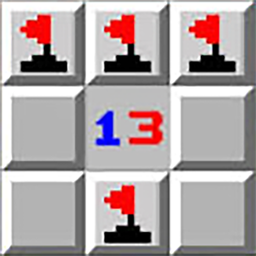
Every visible number counts mines in the squares touching it. A corner clue can touch three squares, an edge clue can touch five, and an interior clue can touch eight. Flags already placed around a clue count toward its total.
Two basic deductions solve much of a beginner board:
- If a clue still needs as many mines as it has covered neighbors, all those neighbors are mines.
- If a clue already touches its full number of flagged mines, every other covered neighbor is safe.
For example, imagine a visible 1 touching only one covered square. That square must contain a mine, so flag it. If a different 1 touches one flag and two other covered squares, both unflagged squares are safe and may be opened.
Count locally and carefully. Before acting on a 2, ask how many adjacent flags it already has and how many adjacent squares remain covered. A 2 with one flag does not require two more mines. It requires only one.
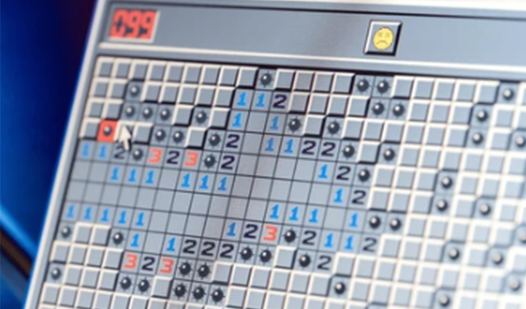
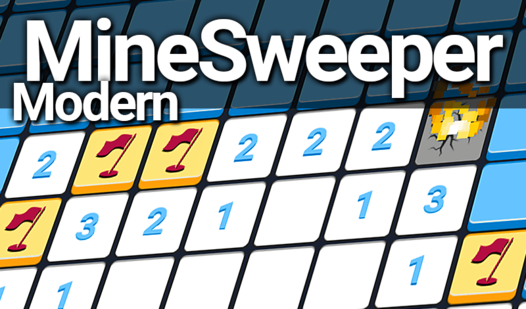
In a 3D variant the presentation may change, but the logic remains based on adjacency. Rotate or inspect the board until you understand which cells count as neighbors, then apply the same remaining-mines calculation.
3. Use flags as working notes, not guesses
Place a flag only when the clues prove that a square is mined. A flag does not neutralize a mine, and an incorrect flag can make several nearby clues appear solved when they are not. That creates a chain of false deductions.
A useful habit is to verify every new flag against all numbers touching it. If your flag would make a neighboring 1 touch two flags, something is wrong. Remove uncertain flags and reconstruct the reasoning from confirmed information.
Some interfaces let you open all remaining neighbors of a satisfied clue by pressing both mouse buttons or clicking the number. This action is often called chording. It is fast, but it trusts your flags completely. If one flag is misplaced, chording may open a mine immediately. Beginners should open proven safe squares individually until flag placement feels reliable.
Also watch the mine counter. It usually shows the total mines minus placed flags, not the number of correctly identified mines. A zero counter does not guarantee that every flag is correct.
4. Recognize patterns and compare overlapping clues
Strong play comes from comparing the neighborhoods of adjacent numbers. Suppose one clue touches covered squares A and B and requires one mine. A nearby clue touches A, B, and C and requires two mines. Because A and B together contain exactly one mine, C must be the second mine.
The common 1-2-1 pattern is another useful example. When three clues reading 1, 2, 1 sit along a straight boundary and the three corresponding covered squares are on the same side, the outer two squares are mines and the middle square is safe. Pattern names are shortcuts, not magic rules. Confirm that there are no extra covered neighbors changing the setup.
A 1-2 pattern often reveals a safe square through subset reasoning. If every covered neighbor of the 1 is also included among the 2's covered neighbors, the 2 needs one additional mine in the area outside the 1's neighborhood. Other outside squares may then become determined.
Scan the entire frontier after each move. Opening one square can complete a clue several rows away from where your attention was focused.
5. Separate forced moves from unavoidable guesses
Before guessing, search for forced moves in three passes. First, inspect clues that need no more mines because their flags already satisfy them. Second, inspect clues whose remaining covered neighbors must all be mines. Third, compare overlapping groups of covered squares.
If none of those passes produces a move, the position may genuinely require probability. Some versions generate boards that can always be solved logically, while traditional generators can create ambiguous endings. In an ambiguous position, choose the square with the lowest estimated mine risk.
You can estimate risk by listing the valid mine arrangements around a frontier. For quick play, use a simpler rule: prefer a square constrained by clues that imply a low local mine density. A square beside a 1 shared among four unknown cells is usually more attractive than a square in a group where two of three cells must be mined. This is only a heuristic because overlapping clues change the exact probability.
Do not automatically choose a corner during a guess. Corners are helpful as opening locations, but their risk later depends on the current clues.
6. Manage the endgame without rushing
Late mistakes often happen because the board looks almost finished. Recount every unresolved clue from scratch. Treat flags as claims that still need to agree with the numbers, not as permanent facts.
Use the total mine count when only a few covered squares remain. If the board contains ten mines, nine are securely flagged, and only two unclassified squares remain, exactly one of those squares is mined. Nearby clues may tell you which one. If all remaining mines are already confirmed, every other covered square is safe even when it is not beside a visible number.
When several disconnected frontiers remain, the global mine total can link them. If one region must contain either one or two mines and another region's clues account for all remaining mines, one possibility may be eliminated.
For faster times, prioritize accuracy first. Then reduce unnecessary cursor movement, use safe chording, and process clusters in a consistent direction. Speed built on guessing produces occasional records but unreliable results.
Practical tips for winning more often
- Recount after every flag and every large automatic opening.
- Work from the most constrained clues, especially numbers with few covered neighbors.
- Open proven safe squares promptly because they may reveal new information.
- Avoid placing speculative flags merely to remember a possible mine.
- If stuck, scan the full boundary before considering probability.
- On mobile, confirm whether long press flags a square before playing quickly.
- Increase board size only after you can solve small boards consistently.
The complete loop is: open a starting area, count adjacent mines, flag only forced mines, clear squares made safe by those flags, and compare overlapping clues when basic deductions stop. You can practice these techniques in Minesweeper and its many variations on nub.games. The games run free in your browser without downloads.