
How to Play Backgammon: Rules, Moves, and Beginner Strategy

How do you play backgammon?
Backgammon is a two-player race in which each player moves 15 checkers around a board of 24 narrow triangles called points. You roll two dice, move according to both numbers when possible, block or hit opposing checkers, bring every checker into your home board, and then bear them off. The first player to remove all 15 checkers wins.
The rules become much easier once you see the game as three connected tasks: escape from your opponent's home board, build safe positions along the route, and gather your checkers before bearing off. The sections below explain a complete turn and the decisions that matter most.
1. Learn the board and starting position

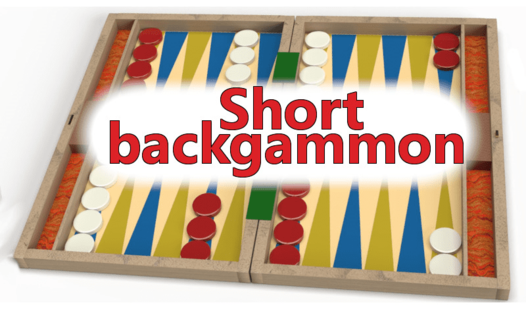
The board has 24 points divided into four groups of six. The raised strip in the middle is the bar. Each player has a home board, where bearing off eventually happens, and an outer board. The players move in opposite directions, so the point numbers are viewed differently from each side.
In standard short backgammon, each player begins with 15 checkers arranged in four stacks: two checkers on the 24-point, five on the 13-point, three on the 8-point, and five on the 6-point. Your 24-point is the farthest point from your exit, while your 1-point is the final point before bearing off.
Many browser versions place the checkers automatically and highlight legal destinations. That is useful, but remember the underlying rule: your checkers always travel in one direction toward your home board. They never reverse direction.
Long backgammon, also called nardy in many games, uses a different initial arrangement and does not normally allow hitting. Check the selected variant before applying short backgammon rules. This guide focuses mainly on standard short backgammon because it is the common international version.
2. Roll the dice and make legal moves


At the beginning, both players usually roll one die. The higher roll starts and uses the two opening numbers. On later turns, roll both dice. Each die represents a separate move, either for one checker or for two different checkers.
For example, with a roll of 3 and 5, you may move one checker three points and another five points. You may instead move one checker a total of eight points, but only if the intermediate point after the first part of the move is legal. The move order can matter: moving 3 then 5 may work when moving 5 then 3 does not.
You cannot land on a point occupied by two or more opposing checkers. Such a point is closed. You may land on an empty point, a point occupied by your own checkers, or a point containing exactly one opposing checker.
You must use both dice whenever a legal sequence exists. If only one number can be played, you must play it. If either number could be used but not both, standard rules require you to use the higher number. If no legal move exists, your turn ends.
A double, such as 4 and 4, gives four moves of that number. You can distribute those four moves among any legal checkers. Doubles are powerful, but every landing point and intermediate point must still be open.
3. Make points, hit blots, and enter from the bar
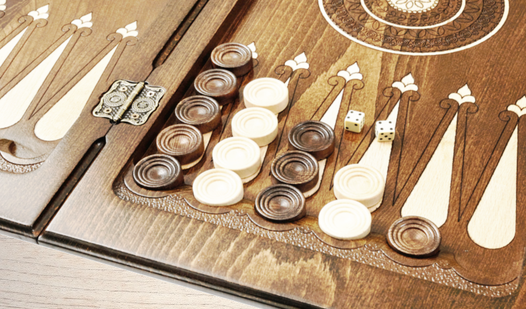
Two or more of your checkers on one point make that point closed to your opponent. Connected closed points form a prime, which can trap checkers behind it. A checker sitting alone is called a blot. If an opposing checker lands on that point, the blot is hit and placed on the bar.
A checker on the bar must re-enter before you move any other checker. It enters through the opponent's home board according to a die number. For example, a roll of 2 allows entry on the opponent's 2-point from your perspective. If that point is occupied by two or more enemy checkers, entry with that die is blocked.
You must use any available entry. If one checker can enter but the other die cannot be played, you enter and lose the unusable part of the roll. If all possible entry points are closed, you lose the whole turn. With several checkers on the bar, enter as many as the dice permit before making ordinary moves.
Hitting is useful because it delays the opponent, but it is not automatically correct. A hit may leave your attacking checker exposed or break an important defensive point. Before hitting, ask whether the checker will be safe, whether the opponent has many return shots, and whether the move improves your overall position.
4. Bring every checker home and bear off
You may begin bearing off only when all 15 of your checkers are inside your home board. If one is hit and sent to the bar, you must re-enter it and bring it home again before continuing to bear off.
An exact roll removes a checker from the matching point. A roll of 4, for example, can bear off a checker from the 4-point. You may also use that 4 to move a checker from a higher point to a lower point if the destination is legal.
If you roll higher than the position of your farthest checker, you may remove that farthest checker. Suppose your 6-point is empty and your highest occupied point is the 5-point. A roll of 6 may bear off a checker from the 5-point. However, you cannot use an oversized roll on a lower checker while another checker remains on a higher point.
Bearing off is still a movement phase, not simply automatic removal. Sometimes it is better to fill gaps or reduce large stacks instead of taking off the maximum number immediately. Balanced distribution often lets future rolls remove two checkers rather than wasting one die.
5. Understand wins, gammons, and the doubling cube

A normal win is worth one point when the loser has borne off at least one checker. A gammon is worth two points when the loser has borne off none. A backgammon is usually worth three points when the loser has borne off none and still has a checker on the bar or in the winner's home board.
Casual browser games may count only individual wins, while match play continues until someone reaches a target score. Always check the displayed rules because scoring options can vary.
Some versions include a doubling cube marked 2, 4, 8, 16, 32, and 64. Before rolling, a player may offer to double the value of the game. The opponent can accept and continue at the higher stake or decline and lose at the current value. After accepting, that player normally controls the cube and may offer the next double later.
Beginners can ignore the cube while learning movement. Once comfortable, treat a double as a question about winning chances, not as a sign of confidence. Offer it when your advantage is meaningful but the opponent may still accept. If the position is already hopeless for them, they will simply decline.
6. Use a simple beginner strategy
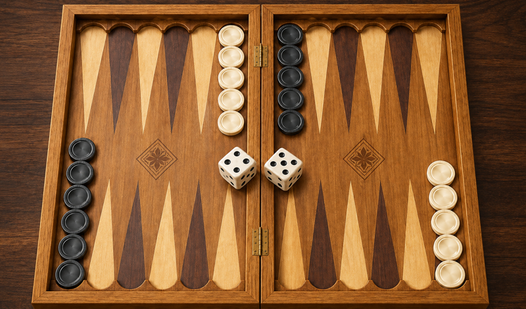
Start by trying to make useful points, especially your 5-point and 4-point. These strengthen your home board and make it harder for a hit opponent to re-enter. Connected points are usually more valuable than isolated stacks.
Move your two farthest checkers, often called back checkers or runners, before they become trapped behind a prime. Do not race blindly, though. When you are behind in the race, maintaining contact can create chances to hit. When you are clearly ahead, reduce contact and bring your checkers home safely.
Avoid leaving unnecessary blots. Count the direct shots: an opposing checker within six points may hit with one die, while combinations can hit from farther away. A blot is often acceptable when it builds a strong point, escapes danger, or hits a more valuable opposing checker.
Do not pile too many checkers on one point. Extra checkers beyond the first two do not strengthen the block. Use spare checkers as builders for new points, but keep enough protection that a bad roll does not expose several blots.
During bearing off, clear high points while keeping a reasonably even spread. In close races, count pips, meaning the total number of points every checker still needs to travel. The lower pip count is ahead, although doubles and checker distribution can still change the result.
Practical tips: inspect both dice before moving, test both move orders, look for forced bar entries, and review exposed checkers after every turn. Learn one standard variant first, then try long backgammon or competitive match rules. All the listed games run free in your browser without downloads, so you can practice the full sequence immediately.