
How to Play FreeCell: Rules, Moves, and Winning Strategy

How do you play FreeCell?
FreeCell is a solitaire game in which you move all 52 cards from the tableau to four foundation piles. Foundations are built by suit from Ace to King. On the tableau, cards are arranged in descending rank with alternating colors. Four free cells can temporarily hold one card each, giving the game its name and creating most of its strategy.
Unlike many solitaire variants, every card is visible from the beginning. Winning therefore depends less on luck and more on planning. Your main task is to uncover low cards, preserve useful storage space, and create empty tableau columns without trapping important cards.
1. Learn the layout and objective


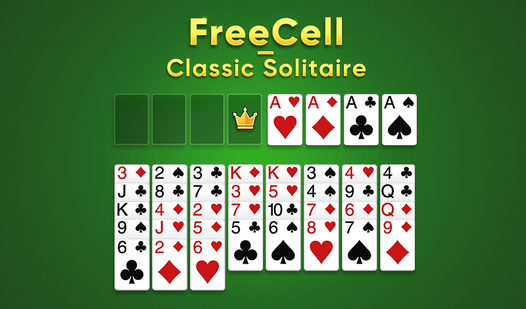
A standard FreeCell deal uses one deck with no jokers. The cards are dealt face up into eight tableau columns. Four columns contain seven cards and four contain six. There is no stock pile and no additional deal later in the game.
Above the tableau are two groups of spaces:
- Four free cells, each of which can hold one card.
- Four foundations, normally one for each suit.
To win, move every card to the foundations. Each foundation must begin with an Ace, followed by the 2, 3, and so on up to the King of the same suit. For example, the 4 of clubs can go onto the 3 of clubs, but not onto a card of another suit.
You can move only exposed cards. An exposed card is the bottom card of a tableau column or a card already sitting in a free cell. Since all cards begin face up, you can inspect the complete deal before making your first move.
2. Understand legal tableau moves
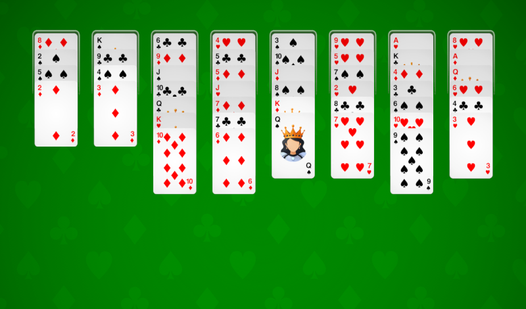
On the tableau, place a card onto a card that is one rank higher and the opposite color. A black 8 can receive a red 7, while a red Queen can receive a black Jack. Suits do not matter for tableau building, but color and rank do.
A single exposed card may be moved to:
- A valid tableau card.
- An empty tableau column.
- An empty free cell.
- Its correct foundation pile.
You can also move an ordered sequence, such as a black 8, red 7, black 6. However, FreeCell treats this as a series of individual moves made with the available temporary spaces. The number of cards you can move together depends on how many free cells and empty tableau columns are available.
A useful basic rule is that with no empty columns, you can move one more card than the number of empty free cells. With three empty free cells, for example, a sequence of up to four cards can be moved. Empty columns increase this capacity significantly because they can serve as temporary staging areas. Some browser versions calculate legal sequence moves automatically, so selecting the sequence and its destination is enough.
3. Use free cells without filling them too early
Free cells are temporary storage, not permanent parking places. Moving a blocking card into a free cell can expose an Ace, complete a sequence, or help empty a column. But every occupied cell reduces your ability to reorganize longer stacks.
Before placing a card in a free cell, decide how it will leave. A strong temporary move has a clear exit, such as placing a red 6 there when a black 7 will soon become available. A weak move stores a high card with no suitable destination, leaving that cell blocked for much of the game.
Try to keep at least one free cell open whenever possible. It provides flexibility if a newly exposed card blocks your plan. If all four cells are full, even a simple five-card sequence may become impossible to move.
Cards in free cells remain playable. They can go to foundations or return to legal tableau positions. Check them regularly because players often focus on the columns and forget that a useful Ace, 2, or connecting card is waiting above the tableau.
4. Create and protect empty columns
An empty tableau column is usually more valuable than an empty free cell. It can temporarily hold any exposed card, including a King, and it helps you move longer sequences. Emptying a short column is therefore a common early objective.
Do not fill an empty column automatically. First ask what the space can accomplish. It may let you:
- Move a long alternating sequence.
- Relocate a high card that blocks several useful cards.
- Reverse the order of a small stack through temporary moves.
- Transfer cards between two crowded columns.
If you place a single low card into the empty column without a continuation plan, the space may stop being useful. Kings are natural candidates because no card can be placed above them in a descending sequence, but even a King should be moved only when it opens something important or builds a productive column.
Remember that moving a sequence into the last empty column removes the extra capacity that the column provided. A move can be legal now while leaving you unable to move the same sequence again. Plan both the destination and the next route before committing.
5. Build foundations carefully

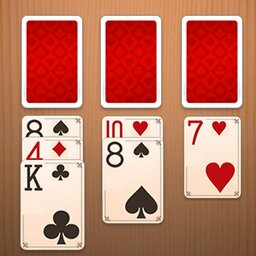
Aces and 2s are usually safe to send to the foundations immediately. Low cards rarely contribute much to tableau organization, and removing them reveals more useful cards. Higher cards require more judgment.
Moving a card to a foundation is not always harmless. Suppose a red 6 is needed as a landing place for a black 5 that blocks an important column. Sending that red 6 away too soon may remove the only available connection. Some versions allow foundation cards to return to the tableau, but you should not depend on that unless the controls clearly support it.
Build suits at a reasonably balanced pace. If one foundation advances to 9 while another is still waiting for its 3, useful alternating-color cards may disappear from the tableau too early. Before moving a mid-rank card up, check whether lower opposite-color cards remain buried.
Automatic foundation moves are convenient, but review the position if the game offers an auto-play setting. Conservative auto-play is generally safe. Aggressive auto-play can occasionally take a card needed for maneuvering.
6. Plan a deal from the first move to the finish
Start by scanning the entire tableau. Locate all four Aces and note which low cards cover them. Then identify the shortest column and any useful alternating sequences already present. Your opening moves should normally pursue three goals: release low cards, consolidate sequences, and empty a column.
Avoid making a legal move merely because it is available. Compare alternatives by asking which move reveals a useful card, preserves more empty spaces, or connects two sequences. If one move exposes a 2 while another exposes a Queen, the low card is often more urgent because it unlocks foundation progress.
When stuck, work backward from the blocked card you need. Find its valid destination, then determine what must move to uncover that destination. This turns a crowded layout into a sequence of smaller problems.
Practical habits improve results quickly:
- Inspect the whole deal before touching a card.
- Keep free cells open and give every stored card an exit plan.
- Prefer moves that expose Aces, 2s, and other low cards.
- Treat empty columns as strategic resources.
- Build clean alternating sequences when possible.
- Check the consequences before sending mid-rank cards to foundations.
- Use undo to study a failed plan when the version provides it.
- Restart and try a different opening if you reach a genuine dead end.
Most FreeCell deals are solvable, but a solution may require delaying an obvious move or reorganizing the same cards in a different order. Take your time, preserve mobility, and think several moves ahead. You can play the FreeCell games above free in your browser without downloads.