
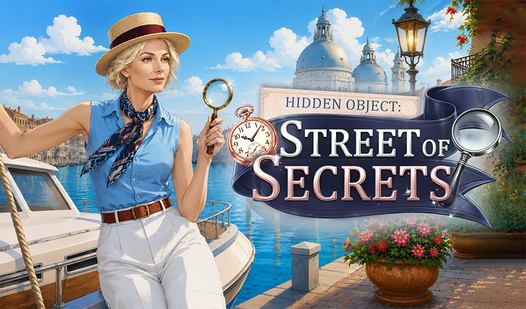
Hidden Object: Street Of Secrets Guide, Scene Walkthrough And Search Tactics

To finish Hidden Object: Street Of Secrets, search by route rather than by random scanning: large objects and outlines first, then scene edges, then areas with dense decoration and shadows. The main secret is understanding that an item can be part of a sign, pattern, shop window or silhouette. Hints are best saved until after a full zone check, not used at the first difficulty.
Quick Search Plan
Hidden object scenes are intentionally overloaded with detail. If you look at the whole screen at once, attention gets tired quickly. Divide the image into zones: top, center, bottom, left edge and right edge. In each zone, search by one type of clue. Start with shape, then color, then meaning. A round object might be a coin, button, stamp or part of a sign. A long thin object might be a key, feather, pen, tool or decorative line.
After the first pass, check the item list again. The remaining objects are often not the smallest ones, but the ones drawn in the least expected way. The game hides them inside similar textures: metal among railings, paper among posters, a bottle among glass, or a key beside fittings.




How To Inspect The Street
Street scenes differ from rooms because they contain natural visual noise: signs, windows, bricks, lamps, wires, benches, shadows and reflections. Items often disguise themselves as city details. Start with object borders. Look along roof outlines, window frames, shop windows, steps and benches. It is easy to hide an object with a similar shape inside those lines.
Do not ignore vertical space. Players often inspect the lower part because that is where "real" objects usually lie. In hidden object games, the target can be on a sign, balcony, lamp or upper window. Make one separate pass through the top third of the screen. Then check the bottom third: baskets, thresholds, boxes, plants and pavement.
Working With The Item List
If the list uses words, translate each word into several possible images. A "star" can be a real star, badge, pattern, toy or part of a logo. A "key" can be a metal key, drawn symbol or sign detail. This wide search is especially important in stylized scenes.
If the list uses silhouettes, do not trust the size. A silhouette shows shape, not exact scale. The item can be smaller or larger than expected, rotated at an angle or partly covered by another object. Compare the main features: curve, teeth, hole, handle and symmetry. That is more reliable than searching for an exact copy of the list image.
Hints And Breaks
A hint is needed not when searching becomes boring, but when your method is exhausted. Before using a hint, do three things. First inspect corners and edges. Second check places with many small objects. Third change the scale of attention: if you searched by color, search by shape; if you searched by shape, search by meaning.
A break really helps. After several minutes, the brain starts skipping obvious details because the scene feels familiar. Look away, return, and begin from the opposite side of the screen. If you were moving left to right, move right to left. This simple reversal often reveals an item that was visible all along.
Avoiding Random Clicks
Random clicks hurt even when there is no penalty. They create a sense of chaos, and you stop remembering which zones have already been checked. Click only after a quick confirmation: the object matches the shape, fits the meaning, and sits in the zone you are currently inspecting. If you are unsure, leave it for the second pass.
Use an internal checklist: zone checked, top checked, edges checked, list reviewed. This turns chaotic scanning into a route. In hard scenes, the winner is not the fastest clicker, but the player who returns to already checked places less often.
Secrets Of Disguised Items
The hardest objects usually hide in one of four ways. The first is color matching, where the object blends into the background. The second is shape matching, where it becomes part of a pattern or architecture. The third is partial cover, where only half is visible. The fourth is meaning substitution, where the target appears as a drawing, emblem or shadow.
When an item cannot be found, decide which hiding method is most likely. If you need a metal object, check railings, lamps, locks and handles. If it is paper, inspect posters, books, letters, menus and notices. If it is small and round, inspect coins, buttons, badges and patterns. This themed search is faster than viewing the entire screen again.
Beating A Dense Scene
If the scene feels too crowded, clear the obvious items first. Find the 30 to 50 percent of objects that are visible without effort. This shortens the list and frees attention. Then switch to the remaining objects one by one. Do not hold the whole list in memory at once. Choose one item and search for only its forms in each zone.
After finding a difficult object, pause and inspect nearby details. Developers often group several finds in one dense area. If you found an item inside a shop window, another listed object may be close: a small sign, paper, decoration or key. This local recheck saves time.
Common Mistakes
The first mistake is searching for an item only in its usual place. In a street scene, a knife does not have to be on a table, and a flower does not have to be in a pot. It can be drawn on a sign. The second mistake is not looking up. Upper windows, balconies and signs are often used for hiding. The third mistake is using a hint on an item that could be found after changing the route.
Another mistake is confusing brightness with importance. Bright objects often distract, while the needed item may be dull and partly covered. If your eye keeps returning to one bright place, deliberately move to another corner. That helps escape the visual trap.
Training Your Attention
Hidden object games reward a few simple habits. The first is looking at negative space, meaning the gaps between objects. Thin silhouettes often hide there. The second is changing viewing distance: make one pass for large shapes and another for tiny details. The third is not staying in one zone for more than a minute. If the item does not appear, switching areas is usually better than staring harder.
Category search also helps. When different items remain on the list, group them mentally: round, long, paper, metal, natural, signs and symbols. Then search for a category instead of one exact word. This works especially well in street scenes, where many objects become part of signs, windows and architecture. You depend less on the exact item name and notice hidden shapes faster.
If your attention is tired, change not only direction but also distance from the screen. Move slightly back to see large silhouettes, then come closer and inspect small details. This simple method helps reveal objects that were too close to a similar background or lost among decorations.
Another trick is to cover or mentally block the part of the scene you have already checked and work only with the remaining zone. This keeps your eyes from returning to the same bright details. It is especially useful when the last item hides near the frame edge instead of the center.
When you find an item, remember how it was hidden. If it was drawn on a sign, the next difficult object may also be an image rather than a physical thing. The game often repeats hiding methods inside one scene.
One final useful step is checking repeated textures. Bricks, boards, leaves and glass create backgrounds where outlines hide easily. A slow pass through those zones often clears the final target.
FAQ
How do I finish Hidden Object: Street Of Secrets faster?
Divide the scene into zones, search large shapes first, then edges and dense decoration. After the first pass, choose one remaining item and search only for its features.
Why can I not see the last item?
It usually blends with the background, forms part of a pattern, or appears as a drawing, emblem or shadow instead of a real object. Change the scan route and check edges.
When should I use a hint?
Use a hint after three checks: corners and edges, areas with small details, and a search using a different logic. If none works, the hint is justified.
How do I avoid random clicking?
Work by zones and click only when the object fits both shape and meaning. Random clicks make it harder to remember which parts of the scene are already checked.